A sweary—and expertly punctuated—weblog.
Showing posts with label art. Show all posts

Thursday, September 9, 2010

The best just keeps on getting better

Sigh. Many of you will remember Jon McNaughton, whose unfettered artistry I sampled in a recent post. Well, he's at it again:

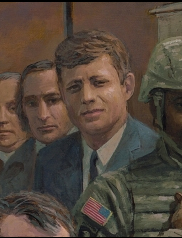
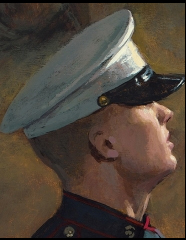
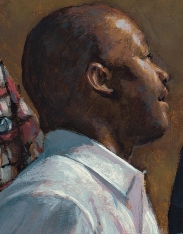
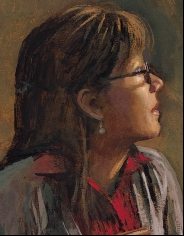
The Forgotten Man!
(Incidentally, one of the cutest parts of McNaughton's site is his right-click blocker, which soberly informs you that the images on his site are copyrighted. I just want to pat him on the head and ruffle his hair!)

Perhaps he realized that playing artist-in-residence to the fringe right generates notoriety and its corresponding profits. I can hear Ayn Rand's post-mortem exultation from all the way over here.

I seriously considered not writing about this painting—there isn't much to say that doesn't also apply to McNaughton's previous offering—yet after the enthusiastic response to my previous post I feel duty-bound to share it. It's all here, just as before: the crushingly heavy-handed political message, the workmanlike copy-and-paste historical portraiture, the inarticulate rebuttal of "liberal" criticism. So as much fun as it would be to tear The Forgotten Man limb from limb, allow me instead to offer summary criticism. It's a better use of everyone's time.

Art transcends the prosaic machinations of day-to-day politics. It may reflect on its times, but when it does so it captures their essence rather than regurgitates their tiresome details. Decades from now we will have largely forgotten the political minutiae responsible for the controversies over which we so bitterly disagree, their particulars no more noteworthy than the 1791 whiskey tax or the merits of bimetallism. Yet McNaughton glorifies the petty conflicts, disgorging one-sided talking points as though they were timeless truths plucked from the tree of knowledge. He panders to the immediate present, and the result has a correspondingly short shelf life. He wants us to accept it as art, but it isn't; it's a political cartoon whose medium happens to be oil on canvas.

Sunday, August 22, 2010

Deconstructive criticism (or: The Pixar model)

Getting a Ph. D. is hard, you guys.

As an undergraduate, I could be a guy who knew stuff. Classes gave me material to learn, and as long as I mastered that material I could confidently expect success. It wasn't easy, necessarily—learning subtle and unfamiliar concepts demands effort—but it was clearly defined; there was never any mystery in how to succeed. Classes had well-encapsulated curricula, insulating me from my ignorance, distracting me with newfound knowledge while keeping me from knowing what I didn't know.

Graduate school is exactly the opposite. Your first task is to become familiar with the literature in your discipline, which is no small feat. Even within a single discipline there are more ideas than you can internalize, more papers than you can ever possibly read. And since graduate research is highly individualized, there can be no master syllabus of necessary and sufficient papers. You must therefore decide for yourself what to learn. Rather than being led through a carefully-crafted curriculum, you get a shocking, unstructured look at your ignorance—an ignorance you can only selectively remedy. And, for good measure, there's no one to administer a quiz at the end to make sure you understand it correctly. All of this means that even after reading a bunch of papers it's hard to have confidence that you know enough to carry out successful research.

It's even harder when doing your own research. This isn't just because the problems to be solved are difficult. In fact, I bet most researchers would agree that actually doing the work is the comparatively easy part of graduate school. Instead, the hard part is knowing what to work on. The great struggle of a scientific Ph. D. is finding a problem that is simultaneously important, unsolved, and solvable. And there's no formula—at least, none that works—for finding such a problem. It's relatively straightforward (again, not easy, but usually straightforward) to sit down and start doing a little math. It's hard to know whether or not that math is going to lead to anything important. The path to Ph. D. is a ragged serpentine, full of blind alleys and unintended excursions.

And you have to do it alone. One of the most terrifying realizations of graduate school is that your advisor does not have the answers. He doesn't fully understand what you're working on. He doesn't know whether or not that work will yield publishable results. Hell, he usually doesn't even know whether or not there are mistakes in your work. He doesn't have time to hover over your shoulder and micromanage your progress. He can give you valuable advice from his experienced (but information-poor) perspective, but no one knows your research as well as you.

This shift the burden of criticism back onto you. You have to look through your own work, scour it for flaws and weaknesses, and decide whether or not you're doing fruitful research. In part this is a healthy exercise: anyone who hopes eventually to head his own research program needs to learn to discern good work from bad. And, in any case, healthy self-criticism is an important part of being a well-adjusted member of society.

But let's be honest: self-criticism is hard. Every talented person wants to believe he is talented, secretly fears he is not, and furtively goes about proving to himself and others that his fears are unjustified. Graduate students routinely suffer crises of confidence, and even honest self-criticism can aggravate the symptoms. Yet academic research is sufficiently demanding that confidence—perhaps even unreasoning, absurd overconfidence—is an essential component of success. It's nearly impossible to fruitfully chase down an idea while tending nagging fears of making mistakes or wasting time down blind alleys.

So, as a researcher you face a dilemma similar to that of an artist. Pay too much heed to your internal critic, and you end up paralyzed by self-reflection. Ignore it entirely, and you produce flawed, unimportant, or otherwise self-indulgent output. Every artist, composer, scientist, and writer faces this dilemma, each walking the knife-edge in his own way.

But some walk it really, really, well. I recently came across an article describing the creative process at Pixar. (If you don't like Pixar films, then you're either too cool, have a heart made of stone, or otherwise suffer from crippling personality flaws. Seek professional help.) Pixar has consistently output innovative, high-quality films, and they achieve that success through interesting means. Every morning, animators and directors gather to examine the work completed the previous day and pick it apart in excruciating detail—deciding what works, what doesn't, and how it should be improved. The animators then take the criticism back to the drawing room and implement these changes. Rinse and repeat until you have a masterpiece on your hands.

In one sense it's not terribly surprising that Pixar's formula is successful. Take a bunch of creative and talented people, create a highly collaborative work environment, and you get phenomenal success! How... non-obvious? But their story struck me in a non-obvious way. How much easier is it to silence the self-critic when you know that a group of your smartest, most talented friends is going to go over your work tomorrow, looking for flaws you overlooked? How much easier is it to be freer, more daring, and more innovative when you know that other talented people are going to keep you from going too far off the deep end?

As someone who suffers from an overactive internal critic, it sounds liberating to me. It's not that I want to avoid the responsibility of evaluating my own work but that I could do it much more effectively with constant, systematic oversight from respected, talented colleagues. As I look forward to the (hopeful) future of running my own research group, the Pixar model appeals to me.

Of course, implementing it presents serious challenges. In describing the model I've tacitly assumed that you have a group of talented people, each of whom is secure enough in his talents and secure enough in his colleagues' that he will not only accept criticism without feeling attacked but also give criticism without attacking. That's a work environment that must be difficult to create and even more difficult to maintain—especially among smart, successful people whose overdeveloped superegos have gotten them far in life. It probably requires a strong sense of shared objective that's hard to foster among creative, independent thinkers.

I don't know what the answer is, but Pixar's success gives me optimism. They've proven that such an environment is possible to create and to maintain for well over a decade. Can't I hope to achieve a creative environment that crusty ol' Steve Jobs has pulled off?

[PS: Made on a Mac!]

Thursday, June 24, 2010

The best art of all the art

We're in Utah this week, attending my sister's wedding and hoping to see some old friends while we're here. We moved away from Provo nearly two years ago, and I'm surprised to find just how nice it is to be back. Not only are the surroundings much, much more beautiful than anything Houston has to offer, but Provo also has a bright, cheerful air that I both admire and miss. Fueled as it may be by equal parts naïveté and self-delusion, Provo's happy-go-lucky optimism makes me feel at home in a way I never could have anticipated while I lived here.

Reconnecting with our Utah roots, Amanda and I wandered around BYU campus for a few hours, eating lunch at the Cougareat, visiting old classroom halls, and eventually perusing the BYU bookstore. In addition to the usual university bookstore fare—hats, T-shirts, and textbooks—there's also a candy store, a floral shop, and a gallery where you can purchase art frames and (mostly LDS-themed) paintings.

You can also purchase terrible, terrible shit.

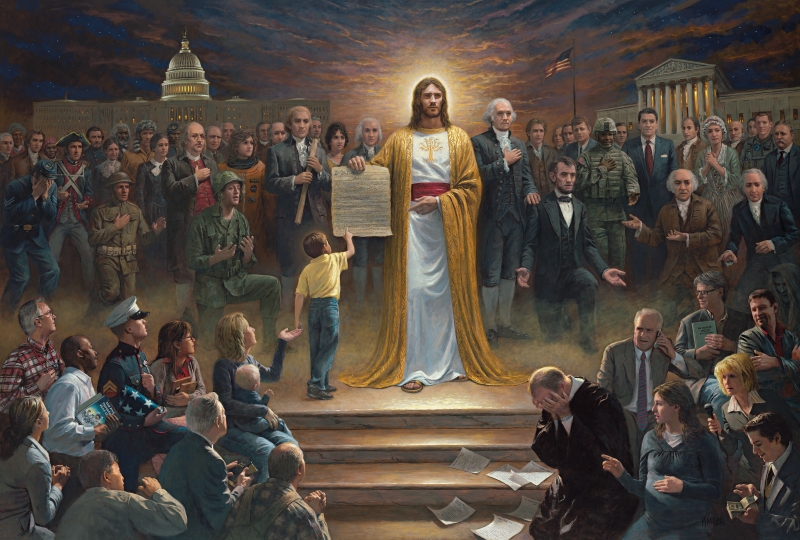
While browsing the gallery I came across this painting, prominently displayed, by Utah-based painter Jon McNaughton:

Initially I just laughed at what I considered a simplistic, oh-so-Utah expression of religion-cum-patriotism, appropriately rendered in the artless schlock of Thomas Kinkade. As I looked closer and realized the specificity of the artist's "message", however, my emotions began to vacillate between acute annoyance and a long-shot hope that this thing might be a marvelously subtle joke.

Sadly, McNaughton earns no points for irony. His painting may look like an exercise in self-caricature, but the humor is unintentional. That you might understand my frustration—and that I might blow off a little steam—allow me to turn my trained artistic eye on this painting and provide a critical exposition.

The central focus of the painting is Jesus Christ holding the U. S. Constitution up to the world.
This makes sense because Jesus actually wrote the Constitution and revealed it to the founding fathers—devout Christian men like Benjamin Franklin, Thomas Paine, and Thomas Jefferson.
Divine authorship of our Constitution is the main reason that the U. S. is the best country of all the countries. So it's important that we immortalize that in our art.

Along with the requisite historical figures flanking the Author and Finisher of our Constitution, there are a few "modern" presidents whose presence is worth mentioning. Obviously Ronald Reagan, who by construction was the most benevolently badass President, supports Jesus and His pro-American agenda. Curiously, however, JFK is also represented among the Constitutional vanguard. As the only righteous representative of American liberalism, his inclusion can only be explained by his willingness to kill godless Communists.


The lower half of the painting is given over to a depiction of the modern American public, divided into two groups who, significantly, are on the right- and left-hand sides of Jesus. On His right hand, obviously, are the ordinary, decent Americans who Believe in and Uphold the Constitution. Their simple patriotism is rendered in stereotype: there's a soldier in uniform, a mother with child in arms, and a simple, working-class man in plaid and overalls.

In a laudable effort at racial inclusion, a lone black man is counted among the righteous—presumably because he's got his copy of Skousen in hand. (Non-LDS readers should be advised that W. Cleon Skousen was an influential LDS author in the 50s and 60s, writing on both political and religious topics. Whatever his other accomplishments, politically he was a conspiracy-theoretic crank. To wit: Glenn Beck has recently promoted his books in an ill-conceived effort at instigating a Skousian renaissance.)

Finally, we have a school teacher, who reminds us that education is an acceptable vocation among the righteous, but only if you restrict yourself to no further than secondary education and appear as mousy as possible while actually in the act of teaching.

On His left hand are the wicked, unpatriotic individuals whose nation-hating nature is indicated by their association with The Devil Himself!

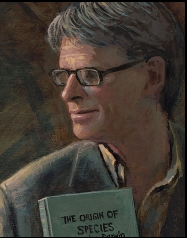
Most of the evil are easy to identify. The secular scientist looks smugly down on the proceedings through trendy rectangular frames, his arrogance and godlessness manifest in the way he clutches his copy of Darwin's Origin of Species. (Never mind that over 100 yeas ago Darwinian evolution was officially declared to be compatible with LDS doctrine, or that modern evolutionary synthesis is taught as a matter of course in BYU biology classes.)

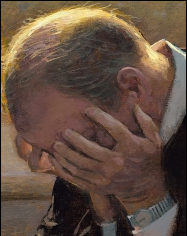
The activist judge buries his face in despair, realizing that Jesus is here to save the Constitution by eradicating his evil, liberal rulings (including Marbury v. Madison, which set the precedent for judicial review; I wonder what McNaughton thinks of Brown v. Board of Education?).

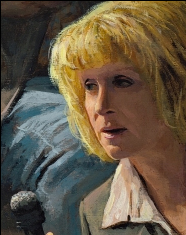
Others are harder to puzzle out. I suppose the microphone-toting blonde is an agent of the MSM, peddling her liberal propaganda to a populace of proletarian sheeple? It's hard to say.

It's even harder to guess at the money-counting businessman or the near-to-bursting pregnant woman. Their politics seem ambiguous at worst and Jesus-friendly at best. Why are they condemned to kick it with The Devil Himself?


All sarcasm aside, this painting is beyond absurd; it's odious. It seeks to legitimize a narrow, nasty, and monolithic ideology—one that rewrites history, cheapens patriotism, and demonizes disagreement—under the guise of fine art. It's an affront to any who believe that the LDS faith comes with no political strings attached, that Mormonism neither prescribes nor proscribes any political platform. It's discouraging enough that this sort of painting generates enough demand to keep McNaughton's studio solvent; that it's popular enough to be featured at an educational institution is pathetic.

It has been famously asked why the LDS community, while over-represented in business, law, and politics, produces so few great artists. I believe the answer is bound up in the kind of art the LDS community wants to consume, which, based on the preceding, isn't very good. Art challenges, is subtle, is occasionally subversive or controversial. And the rank-and-file LDS community isn't interested in controversy or subtlety, but in consuming media that brazenly reinforces its worldview. So for every Orson Scott Card, Minerva Teichert, or even Arnold Friberg (who managed a much more tasteful synthesis of spirituality and patriotism), there are dozens of Stephanie Meyers, Janice Kapp Perrys, and Michael McLeans. Jon McNaughton is merely a particularly egregious example of the countless LDS artists whose work does not inspire, but ploddingly reinforces stale, suffocating orthodoxy.

And that isn't art. It's kitsch. It's the opposite of art. It destroys art. It destroys souls.

[PS: It turns out you can read McNaughton's interpretation of the painting, as well as his response to "liberal" criticism. I think you will find his rhetorical chops exactly commensurate with his artistry!]