I gave the following talk at a Mormon Stories conference yesterday here in Houston. Since I haven't posted anything detailed on how I left Mormonism, I thought that some of you might appreciate reading this. The talk was recorded, and the live version is available here.
I’d like to begin with two disclaimers.
First, while I’m the one standing up here and telling the story — and while I’m certainly telling it from my perspective — this is our story. It's a story of how I left Mormonism, how Amanda has remained an active member, and how our relationship has survived in spite of our differences. It’s a story about both of us, in other words. It’s too bad that there isn’t time for both of us to tell our sides of it, and I find it a bit anti-feminist — especially for Mormon Stories! — that I’m the one up here. But here we are. The consolation prize is that we get to break the usual Sacrament Meeting convention: Here it’s the husband who has to introduce the family to the new ward, not the wife!
Second, I don’t want anyone to think we have marriage advice to give out. We know we got off easy: we’re young, we have no kids, and our situation is much less complex than many others'. All I can do is to tell what we’ve been through and to share a few insights that we’ve gleaned along the way. The predictive value of our experiences, or the applicability of our insights to individual circumstances, I’m simply not willing to claim.
With those out of the way, let me lay out my thesis: Stable, healthy marriages between active Mormons and ex-Mormons are possible. New apostates often feel like the only way to save their marriage is to deconvert their spouse. I believe this to be a largely false and harmful idea. I also believe that the shift in worldview that often accompanies a faith crisis gives the apostate two insights that can help stabilize a mixed-faith marriage. One, belief doesn’t have much to do with intelligence. Two, belief doesn’t have much to do with morality.
By Mormon standards, my upbringing was pretty ordinary. I was born in Tacoma, Washington, to parents of pioneer ancestry. Dad worked in business while Mom stayed home with the five kids. We were loyal Republicans. I hit all the usual milestones. I was baptized at 8, ordained to the Aaronic priesthood at 12, and at 18 I graduated from high school and was shipped off to BYU, where I picked a safe, marketable major.
After my freshman year, I put in my papers and was called to the Australia Perth Mission.
I had always believed in Mormonism, and I felt like it held together logically. But I also subscribed to the Mormon epistemology that I could know — through unmistakeable spiritual witness — that it was True. And I’d never had such a witness. So while I left for my mission not “knowing” if the Church was true, I had every expectation of receiving a witness while teaching the gospel. I was not disappointed. In the early months of my mission, during a small handful of our very rare opportunities to teach, I experienced a profound, naked human connection as we testified of the gospel and as our testimonies were received. Even now, as an unbeliever and a thoroughgoing materialist, I consider these experiences meaningful and even transcendental. As an idealistic young missionary hungry for spiritual validation, I considered them an indisputable manifestation of the Holy Spirit. I completed my mission and returned to BYU confident that I knew, not merely believed, and that my faith would endure for the rest of my life.
I was wrong. In fact, my faith endured for only a few years. My faith started its transition as I worked on my master’s degree. I was still at BYU, and I wasn’t studying anything that would challenge a testimony, but the transition from undergraduate study to graduate work has a way of forcing self-skepticism on a person. And that’s because research is difficult and unstructured. Suddenly, instead of being the guy who can master difficult concepts and solve problems on exams, I was the guy suggesting wrong-headed solutions to research problems. I went from being very rarely wrong in my area of expertise to being wrong every single day. And I came to learn that this was perfectly normal. Being wrong was part of the program. The first of my two insights began to set in: When the questions are hard, even smart people are wrong all the time. Belief has little to do with intelligence.
Around this time I met Amanda. Her upbringing was less stereotypically Mormon than mine. She grew up in Dallas. Her parents had converted to Mormonism in the mid 70s. By Mormon standards they were politically left-of-center. In their household, belief in evolution did not contradict belief in Mormonism. Gays and lesbians were regarded as good, decent people, and although you might share an honest difference of opinion with them there was no reason to condemn or avoid them. It was still an orthodox Mormon home, both in terms of belief and practice, but it was less rigid than that of many of her peers.
When Amanda and I met, she had just finished her degree at BYU in anthropology. Our first meeting, a chance encounter by the apartment complex pool, got off to an auspicious start. I made some jokes, she laughed at those jokes, and we discussed our academic aspirations. I got her phone number, asked her out, and for the next two years we dated off and on. Around the time I was finishing my master’s degree we began to talk seriously about marriage.
In the meantime, my self-skepticism had put down deep roots. As I realized I could be wrong on technical matters, I also realized I could be wrong about almost anything, and my entire worldview was up for reexamination. I consciously admitted to myself doubts that before I had kept sequestered in the subconscious. I doubted that my missionary experiences were necessarily divine manifestations. I doubted that a few million Mormons, out of the billions of humans on the earth, have any credible claim to exclusive truth. I doubted that there is a life after this one. I doubted that there exists any God at all.
It turns out you can rationalize anything when the stakes are high enough. As we talked more seriously about marriage, I confided in Amanda my doubts — she knew what I was when she picked me up, you might say. But we examined the problem from a very Mormon perspective. We talked about how I was “struggling” with my testimony, and we were optimistic that I would “overcome” my doubts. In other words, we assumed that the right answer — from a purely moral perspective — was for me to find a way to continue believing. And, for a while, I did. Of course I did. I was in love, I wanted to get married, and “overcoming” my doubts was a precondition for getting married. We got engaged a few weeks later, got married a few months after that, and immediately afterwards we left for Houston so I could pursue my Ph.D. at Rice.
It was another six months before my doubts resurfaced, and they did so with a vengeance. Somewhere in those six months the second insight had set in: belief has little to do with morality. I’m not sure exactly what caused it — maybe I just needed to get out of Provo, or maybe it was interacting with a bunch of smart, decent people of diverse backgrounds at Rice. Whatever the stimulus, I no longer believed there was a morally right answer to my doubts. I gave myself moral permission to disbelieve. I began a more serious, and I think more honest, study of my beliefs. I read Amanda’s textbooks on biblical archaeology. I confronted issues with Mormonism that are probably familiar to many in this audience. After a few months, I came to a conclusion: I no longer believed in the truth claims of Mormonism, and I no longer wanted to affiliate myself with the church.
Breaking the news to Amanda was difficult. Of course she had seen it coming. Of course it was something she didn’t want to hear. But she also knew that she couldn’t in good conscience pressure me into continued activity. So I left, and to her credit she came to terms with it. She was too tolerant a person to buy into the rhetoric that apostates are morally degenerate. So once it became clear that I was the same person as an ex-Mormon — once it became clear that I’m an even nicer guy after a few drinks! — she accepted the fact that I had left, and that I probably wasn’t coming back.
But things were still rough, and it was mostly my fault. I was decent enough not to try actively to deconvert Amanda, but I did hold out hope that she would eventually leave. This hope led to a few nasty disagreements. I particularly remember one evening. We were at Arby’s, having a particularly classy night out, and somehow we got to talking about Warren Jeffs and the FLDS church. And I couldn’t resist the urge to stick it to her. I pointed out that FLDS members bear a testimony of Warren Jeffs that isn’t all that different from the one Mormons bear of Thomas S. Monson. How could Amanda have any confidence that her convictions were any more justified than those of an FLDS member?
No amount of beef ‘n’ cheddar could salvage our evening. Arguments like these happened often enough, and were severe enough, to create a sense that our differences were fundamental, that they prevented us from having an emotionally intimate relationship. It was a bleak several months, and we both worried that our marriage was in jeopardy.
The turning point came in October 2010. We were sitting in our living room. Amanda was listening to conference while I wasted time on the internet. And Boyd K. Packer got up to speak. Probably you remember the talk. For all the harm it caused, Packer’s crotchety intolerance may have saved our marriage, and for that I could kiss him on his gruff old mouth. Amanda was outraged. She was too tolerant, and had known too many gay Mormons, to listen to someone she regarded as an apostle of Jesus Christ indulge in hurtful rhetoric she knew to be false.
Now, this wasn’t a turning point because Amanda’s beliefs began to change. Because really her beliefs didn’t change at this point. This was a turning point because it gave us common ground. Here was something about Mormonism we could discuss productively. We were both upset by the damage being done to gay and lesbian Mormons. And we talked about it. Through our discussions I came to a long-overdue realization: Both intellectually and morally, I had seriously underestimated Amanda’s relationship with Mormonism.
I took the two principles that led to my apostasy, and I applied them to believing Mormons in a way I just couldn’t do when I first left. Even though I think the evidence weighs heavily against Mormonism’s truth claims, there still are intelligent, thoughtful reasons to believe. Belief has little to do with intelligence. Even though Mormonism can do a lot of harm, there still remains tremendous good to be found in it and to be done through it. Belief has little to do with morality. I came to respect Amanda’s belief, and I came to accept that, just as I might never return to Mormonism, she might never leave. From then on, Mormonism ceased to be a wedge between us.
Since then, Amanda has begun to deal with her own faith crisis. She has become increasingly unorthodox in her beliefs. She interprets the Church’s truth claims figuratively. She’s gotten involved in activism for the Mormon LGBT community. She participates in Mormon Stories. But this doesn't cause me to breathe a sigh of relief. It’s nice — it gives us even more common ground, and more to the point it’s made Amanda happier — but her faith transition is not essential to our relationship. If tomorrow she returns to orthodox belief, if she decides never again to listen to a Mormon Stories podcast, it wouldn’t have much impact on our relationship.
We don’t know where our faith journeys will lead us. Amanda especially has an unpredictable road ahead, and who knows what the future holds for me. But we’ve stopped worrying how that might impact our relationship. Our marriage is no longer predicated on shared religious belief. Respect for each other’s intelligence and goodness is what’s essential to our relationship. And our particular beliefs don’t say very much about our intelligence or our goodness.
Showing posts with label mormons. Show all posts
Showing posts with label mormons. Show all posts
Sunday, January 22, 2012

Wednesday, February 9, 2011
By Popular Demand
Two people called me out today for a lack of blogging. Two completely unrelated people. It's a mandate if I ever saw one.
The truth is, I'm at a bit of a crossroads blogging-wise. So far, I've used this blog as a venue for hashing out arguments about whatever issue—political, artistic, philosophical—I happen to feel strongly about at the time. And you, my faithful readers, have been good sports about arguing with me about them. It gives me no small pleasure to connect with old friends and indirect acquaintances through well-meaning debate.
Now that I'm out of the apostate closet, however, everything has changed. I'm no fool. I know that most of my regular readers are believing Mormons. And while I consider you a pretty open-minded bunch, I'm not sure how well my musings of late will go down. I'm still undecided about posting the story of my departure from Mormonism, which contains arguments that many of you will likely be predisposed to reject as anti-Mormon lies. Reflections on putting my post-Mormon world together are as likely to alienate my audience as they are to enlighten. And let's be honest: a blog with no readers (and no comments!) is no blog at all. So, not wanting to destroy my blog with overzealous apostasy, I have not blogged at all. (It is a Catch-22, you guys!)
Inspired by the statistical unlikelihood of coincident requests for posts, however, I am breaking the cycle of blog paucity. Brace yourselves.
Secularism is heady wine. I doubt that I can fully communicate it to my LDS friends, but I find not being chained to any system of belief intoxicating and empowering. I relish in the intellectual and moral freedom I have claimed since leaving Mormonism. I no longer have to worry about twisting myself into a belief in self-contradictory or unsupported truth claims. If evidence is lacking, I can discard at will from my epistemological deck. Similarly, I am free to follow my moral compass without compromise. I no longer need dissemble in defense of any creed. I no longer need condemn something as sinful merely because a religious leader commands it. If I cannot see the evil in a particular practice, I am under no obligation to regard that practice as immoral.
This moral freedom, I argue, dismantles one of the few truly evil components of religion. Let me illustrate with an example. In New Jersey, a lesbian couple sought to rent a pavilion, owned by the Methodist-affiliated Ocean Grove Camp Meeting Association, for their civil union ceremony. The OGCMA refused, citing a religious objection to same-sex unions. The couple successfully sued the OGCMA for discrimination, but I don't want to talk about the court case. I want to focus on the following quote, by OGCMA administrator Rev. Scott Hoffman:
I take Hoffman at his word. He probably isn't trying to judge anyone. He probably doesn't even feel that the couple are bad people. I'll go even so far as to conjecture that, in his bones, he finds nothing particularly evil in this couple's desire to formalize their commitment. (If I am wrong about Hoffman, I am not wrong about some of you; I have witnessed firsthand the widespread moral ambivalence over homosexuality in my generation of Mormons.) But his religious convictions tell him that he cannot support same-sex unions, and he does not permit himself the freedom to disagree.
There will always be homophobes, just like there will always be racists and there will always be misopogonists. Such people don't need to be told to condemn; they will always find justification for their cruel and intolerant behaviors. But to make a decent person like Hoffman commit to those same prejudices requires something more. It requires dogma, which religion all too often is willing to provide. At its worst, religion puts a divine seal of approval on the prejudices of the previous generation, compelling the believer to reject even when, left to his own conscience, he would prefer to accept.
Leaving Mormonism has exacted costs both practical and emotional. I can't avoid that. But the freedom from institutional prejudice, the freedom to be as good a person as I make up my mind to be, has made it worth every penny.
The truth is, I'm at a bit of a crossroads blogging-wise. So far, I've used this blog as a venue for hashing out arguments about whatever issue—political, artistic, philosophical—I happen to feel strongly about at the time. And you, my faithful readers, have been good sports about arguing with me about them. It gives me no small pleasure to connect with old friends and indirect acquaintances through well-meaning debate.
Now that I'm out of the apostate closet, however, everything has changed. I'm no fool. I know that most of my regular readers are believing Mormons. And while I consider you a pretty open-minded bunch, I'm not sure how well my musings of late will go down. I'm still undecided about posting the story of my departure from Mormonism, which contains arguments that many of you will likely be predisposed to reject as anti-Mormon lies. Reflections on putting my post-Mormon world together are as likely to alienate my audience as they are to enlighten. And let's be honest: a blog with no readers (and no comments!) is no blog at all. So, not wanting to destroy my blog with overzealous apostasy, I have not blogged at all. (It is a Catch-22, you guys!)
Inspired by the statistical unlikelihood of coincident requests for posts, however, I am breaking the cycle of blog paucity. Brace yourselves.
Secularism is heady wine. I doubt that I can fully communicate it to my LDS friends, but I find not being chained to any system of belief intoxicating and empowering. I relish in the intellectual and moral freedom I have claimed since leaving Mormonism. I no longer have to worry about twisting myself into a belief in self-contradictory or unsupported truth claims. If evidence is lacking, I can discard at will from my epistemological deck. Similarly, I am free to follow my moral compass without compromise. I no longer need dissemble in defense of any creed. I no longer need condemn something as sinful merely because a religious leader commands it. If I cannot see the evil in a particular practice, I am under no obligation to regard that practice as immoral.
This moral freedom, I argue, dismantles one of the few truly evil components of religion. Let me illustrate with an example. In New Jersey, a lesbian couple sought to rent a pavilion, owned by the Methodist-affiliated Ocean Grove Camp Meeting Association, for their civil union ceremony. The OGCMA refused, citing a religious objection to same-sex unions. The couple successfully sued the OGCMA for discrimination, but I don't want to talk about the court case. I want to focus on the following quote, by OGCMA administrator Rev. Scott Hoffman:
The principle was a strongly held religious belief that a marriage is between a man and a woman. We're not casting any aspersions or making any judgments. It's just, that's where we stand, and we've always stood that way, and that's why we said no.
I take Hoffman at his word. He probably isn't trying to judge anyone. He probably doesn't even feel that the couple are bad people. I'll go even so far as to conjecture that, in his bones, he finds nothing particularly evil in this couple's desire to formalize their commitment. (If I am wrong about Hoffman, I am not wrong about some of you; I have witnessed firsthand the widespread moral ambivalence over homosexuality in my generation of Mormons.) But his religious convictions tell him that he cannot support same-sex unions, and he does not permit himself the freedom to disagree.
There will always be homophobes, just like there will always be racists and there will always be misopogonists. Such people don't need to be told to condemn; they will always find justification for their cruel and intolerant behaviors. But to make a decent person like Hoffman commit to those same prejudices requires something more. It requires dogma, which religion all too often is willing to provide. At its worst, religion puts a divine seal of approval on the prejudices of the previous generation, compelling the believer to reject even when, left to his own conscience, he would prefer to accept.
Leaving Mormonism has exacted costs both practical and emotional. I can't avoid that. But the freedom from institutional prejudice, the freedom to be as good a person as I make up my mind to be, has made it worth every penny.
Sunday, December 12, 2010
A skeptical Christmas
I have almost no memory of a belief in Santa Claus.
The single memory I have is nebulous at best. One Christmas Eve, when I was four or five, my uncle pointed out the window and told us he could see Rudolph's nose twinkling in the distance. By now the memory is so old and worn-out that I can't say how much I believed him, but I recall that I scoured the sky with at least some expectation of finding a red glow. Of course, whatever hopes I had were for naught.
On the other hand, I have precisely zero memory of finding out "the truth" about Santa. To the best of my knowledge my parents never sat me down to let me in on the secret, and I never accidentally stumbled upon the presents hidden in my parents' closet. As far as I remember, I just grew out of it. (By the time we got our first Nintendo—1988 or so—I didn't believe. I know this because my brother and I found the Nintendo a week or two before Christmas, a discovery which challenged no one's worldview.) I was lucky never to deal with the emotional trauma or feelings of betrayal that (I hear) other kids have to overcome when they learn their parents have been pulling the wool over their eyes. I just stopped believing.
I'm sure my Santa skepticism was facilitated by the fact that my parents didn't try artificially to keep us believing. (Thanks, Mom and Dad!) But even so, the fact that I can hardly remember believing in Santa Claus is a symptom of a more general condition: I'm a skeptical fellow, and I always have been. In that spirit, perhaps you will not be surprised at the following announcement, which after all this time I can no longer keep bottled up:
One year ago, I left the Church of Jesus Christ of Latter-day Saints.
I've agonized for months over how to tell this story, writing (and frequently discarding) pages and pages of explanation of my decision to leave. Perhaps sometime soon I will post a detailed justification, but for now let it suffice to say that I no longer find the church's truth claims compelling. It's no more complicated than that. There was no pint of cream nor transgression to conceal. I simply no longer believe.
As with Santa Claus, losing my faith in God has been a surprisingly natural process. That's not to say everything has been easy; if nothing else, managing relationships with friends and loved ones who still believe is a work in progress. But I am the same person I was a year ago, the same person most of you know in the flesh. While I do occasionally mourn my lost faith, on the whole I'm as happy now as I ever was inside Mormonism. Certainly I am as fundamentally good and honest an individual as I ever have been. Indeed, other than the occasional adult beverage (for the record: beer is okay, wine is nice, and whiskey is wonderful) my lifestyle is largely indistinguishable from that of an active latter-day saint.
I consider myself rather fortunate to have survived apostasy with so few emotional scars. It means that I need not reject all of the tradition and culture with which I was raised. It means that, while I no longer believe in God, I still love Christmastime. People have wondered at this, and occasionally I have been accused of inconsistency or even hypocrisy on this point. I admit that my accusers have a point, and while I refuse to apologize I will attempt to explain.
Having experienced one-and-a-half Christmases as a non-believer, I now realize that religious belief is only tangential to what makes Christmas special. Christmastime is an opportunity to spend time with the people we love. To eat food and listen to music that connects us to our childhood. To participate in traditions that not only bring us closer to our loved ones, but also reinforce connections to our shared past. I maintain that one does not need a belief in God to sing Christmas carols, to cook and eat festive food, or even go to a Christmas service. This morning I played the cello in Amanda's ward's Christmas program, and last year we attended watchnight services at a 13th-century cathedral. These experiences were not even slightly cheapened by my unbelief.
But of course I can't ignore the religious aspect entirely, and as an apostate from Mormonism I can testify firsthand of the strife faith can cause. Yet I am entirely untroubled by the religious underpinnings of Christmas. Christmas is religion divested of its propensity for ill. It brings a simple, universal message of peace and goodwill, a God-figure as benign and innocent as a newborn babe. Probably there is nothing true about Christmas's religious message. But there is no harm in this.
This is my third Christmas post. If you look back to previous posts, you'll notice that every year I have made some mention of religious skepticism. Christmas has lately been a particular opportunity to explore the crisis of faith with which I have been dealing for several years now. But never—never—has my lack of faith interfered with my ability to enjoy the season.
Merry Christmas to you all.
The single memory I have is nebulous at best. One Christmas Eve, when I was four or five, my uncle pointed out the window and told us he could see Rudolph's nose twinkling in the distance. By now the memory is so old and worn-out that I can't say how much I believed him, but I recall that I scoured the sky with at least some expectation of finding a red glow. Of course, whatever hopes I had were for naught.
On the other hand, I have precisely zero memory of finding out "the truth" about Santa. To the best of my knowledge my parents never sat me down to let me in on the secret, and I never accidentally stumbled upon the presents hidden in my parents' closet. As far as I remember, I just grew out of it. (By the time we got our first Nintendo—1988 or so—I didn't believe. I know this because my brother and I found the Nintendo a week or two before Christmas, a discovery which challenged no one's worldview.) I was lucky never to deal with the emotional trauma or feelings of betrayal that (I hear) other kids have to overcome when they learn their parents have been pulling the wool over their eyes. I just stopped believing.
I'm sure my Santa skepticism was facilitated by the fact that my parents didn't try artificially to keep us believing. (Thanks, Mom and Dad!) But even so, the fact that I can hardly remember believing in Santa Claus is a symptom of a more general condition: I'm a skeptical fellow, and I always have been. In that spirit, perhaps you will not be surprised at the following announcement, which after all this time I can no longer keep bottled up:
One year ago, I left the Church of Jesus Christ of Latter-day Saints.
I've agonized for months over how to tell this story, writing (and frequently discarding) pages and pages of explanation of my decision to leave. Perhaps sometime soon I will post a detailed justification, but for now let it suffice to say that I no longer find the church's truth claims compelling. It's no more complicated than that. There was no pint of cream nor transgression to conceal. I simply no longer believe.
As with Santa Claus, losing my faith in God has been a surprisingly natural process. That's not to say everything has been easy; if nothing else, managing relationships with friends and loved ones who still believe is a work in progress. But I am the same person I was a year ago, the same person most of you know in the flesh. While I do occasionally mourn my lost faith, on the whole I'm as happy now as I ever was inside Mormonism. Certainly I am as fundamentally good and honest an individual as I ever have been. Indeed, other than the occasional adult beverage (for the record: beer is okay, wine is nice, and whiskey is wonderful) my lifestyle is largely indistinguishable from that of an active latter-day saint.
I consider myself rather fortunate to have survived apostasy with so few emotional scars. It means that I need not reject all of the tradition and culture with which I was raised. It means that, while I no longer believe in God, I still love Christmastime. People have wondered at this, and occasionally I have been accused of inconsistency or even hypocrisy on this point. I admit that my accusers have a point, and while I refuse to apologize I will attempt to explain.
Having experienced one-and-a-half Christmases as a non-believer, I now realize that religious belief is only tangential to what makes Christmas special. Christmastime is an opportunity to spend time with the people we love. To eat food and listen to music that connects us to our childhood. To participate in traditions that not only bring us closer to our loved ones, but also reinforce connections to our shared past. I maintain that one does not need a belief in God to sing Christmas carols, to cook and eat festive food, or even go to a Christmas service. This morning I played the cello in Amanda's ward's Christmas program, and last year we attended watchnight services at a 13th-century cathedral. These experiences were not even slightly cheapened by my unbelief.
But of course I can't ignore the religious aspect entirely, and as an apostate from Mormonism I can testify firsthand of the strife faith can cause. Yet I am entirely untroubled by the religious underpinnings of Christmas. Christmas is religion divested of its propensity for ill. It brings a simple, universal message of peace and goodwill, a God-figure as benign and innocent as a newborn babe. Probably there is nothing true about Christmas's religious message. But there is no harm in this.
This is my third Christmas post. If you look back to previous posts, you'll notice that every year I have made some mention of religious skepticism. Christmas has lately been a particular opportunity to explore the crisis of faith with which I have been dealing for several years now. But never—never—has my lack of faith interfered with my ability to enjoy the season.
Merry Christmas to you all.
Thursday, June 24, 2010
The best art of all the art
We're in Utah this week, attending my sister's wedding and hoping to see some old friends while we're here. We moved away from Provo nearly two years ago, and I'm surprised to find just how nice it is to be back. Not only are the surroundings much, much more beautiful than anything Houston has to offer, but Provo also has a bright, cheerful air that I both admire and miss. Fueled as it may be by equal parts naïveté and self-delusion, Provo's happy-go-lucky optimism makes me feel at home in a way I never could have anticipated while I lived here.
Reconnecting with our Utah roots, Amanda and I wandered around BYU campus for a few hours, eating lunch at the Cougareat, visiting old classroom halls, and eventually perusing the BYU bookstore. In addition to the usual university bookstore fare—hats, T-shirts, and textbooks—there's also a candy store, a floral shop, and a gallery where you can purchase art frames and (mostly LDS-themed) paintings.
You can also purchase terrible, terrible shit.
While browsing the gallery I came across this painting, prominently displayed, by Utah-based painter Jon McNaughton:
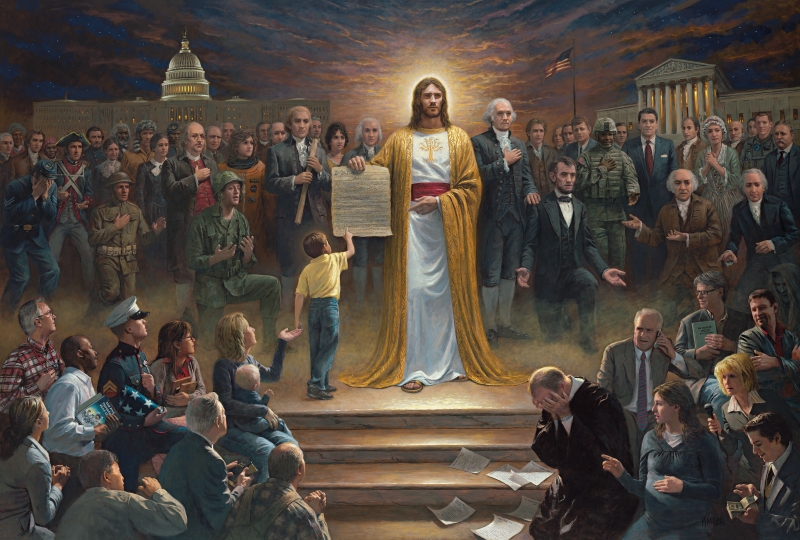
Initially I just laughed at what I considered a simplistic, oh-so-Utah expression of religion-cum-patriotism, appropriately rendered in the artless schlock of Thomas Kinkade. As I looked closer and realized the specificity of the artist's "message", however, my emotions began to vacillate between acute annoyance and a long-shot hope that this thing might be a marvelously subtle joke.
Sadly, McNaughton earns no points for irony. His painting may look like an exercise in self-caricature, but the humor is unintentional. That you might understand my frustration—and that I might blow off a little steam—allow me to turn my trained artistic eye on this painting and provide a critical exposition.
The central focus of the painting is Jesus Christ holding the U. S. Constitution up to the world.
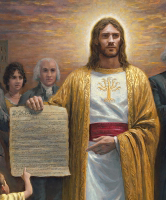 This makes sense because Jesus actually wrote the Constitution and revealed it to the founding fathers—devout Christian men like Benjamin Franklin, Thomas Paine, and Thomas Jefferson.
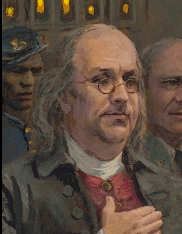
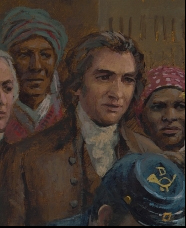
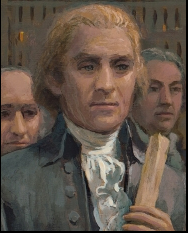 Divine authorship of our Constitution is the main reason that the U. S. is the best country of all the countries. So it's important that we immortalize that in our art.
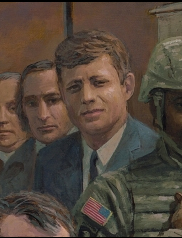
Along with the requisite historical figures flanking the Author and Finisher of our Constitution, there are a few "modern" presidents whose presence is worth mentioning. Obviously Ronald Reagan, who by construction was the most benevolently badass President, supports Jesus and His pro-American agenda. Curiously, however, JFK is also represented among the Constitutional vanguard. As the only righteous representative of American liberalism, his inclusion can only be explained by his willingness to kill godless Communists.

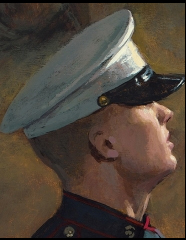
The lower half of the painting is given over to a depiction of the modern American public, divided into two groups who, significantly, are on the right- and left-hand sides of Jesus. On His right hand, obviously, are the ordinary, decent Americans who Believe in and Uphold the Constitution. Their simple patriotism is rendered in stereotype: there's a soldier in uniform, a mother with child in arms, and a simple, working-class man in plaid and overalls.


In a laudable effort at racial inclusion, a lone black man is counted among the righteous—presumably because he's got his copy of Skousen in hand. (Non-LDS readers should be advised that W. Cleon Skousen was an influential LDS author in the 50s and 60s, writing on both political and religious topics. Whatever his other accomplishments, politically he was a conspiracy-theoretic crank. To wit: Glenn Beck has recently promoted his books in an ill-conceived effort at instigating a Skousian renaissance.)

Finally, we have a school teacher, who reminds us that education is an acceptable vocation among the righteous, but only if you restrict yourself to no further than secondary education and appear as mousy as possible while actually in the act of teaching.

On His left hand are the wicked, unpatriotic individuals whose nation-hating nature is indicated by their association with The Devil Himself!

Most of the evil are easy to identify. The secular scientist looks smugly down on the proceedings through trendy rectangular frames, his arrogance and godlessness manifest in the way he clutches his copy of Darwin's Origin of Species. (Never mind that over 100 yeas ago Darwinian evolution was officially declared to be compatible with LDS doctrine, or that modern evolutionary synthesis is taught as a matter of course in BYU biology classes.)

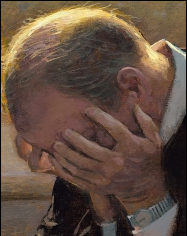
The activist judge buries his face in despair, realizing that Jesus is here to save the Constitution by eradicating his evil, liberal rulings (including Marbury v. Madison, which set the precedent for judicial review; I wonder what McNaughton thinks of Brown v. Board of Education?).
Others are harder to puzzle out. I suppose the microphone-toting blonde is an agent of the MSM, peddling her liberal propaganda to a populace of proletarian sheeple? It's hard to say.
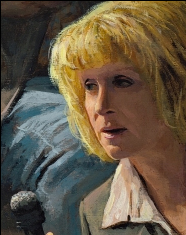
It's even harder to guess at the money-counting businessman or the near-to-bursting pregnant woman. Their politics seem ambiguous at worst and Jesus-friendly at best. Why are they condemned to kick it with The Devil Himself?


All sarcasm aside, this painting is beyond absurd; it's odious. It seeks to legitimize a narrow, nasty, and monolithic ideology—one that rewrites history, cheapens patriotism, and demonizes disagreement—under the guise of fine art. It's an affront to any who believe that the LDS faith comes with no political strings attached, that Mormonism neither prescribes nor proscribes any political platform. It's discouraging enough that this sort of painting generates enough demand to keep McNaughton's studio solvent; that it's popular enough to be featured at an educational institution is pathetic.
It has been famously asked why the LDS community, while over-represented in business, law, and politics, produces so few great artists. I believe the answer is bound up in the kind of art the LDS community wants to consume, which, based on the preceding, isn't very good. Art challenges, is subtle, is occasionally subversive or controversial. And the rank-and-file LDS community isn't interested in controversy or subtlety, but in consuming media that brazenly reinforces its worldview. So for every Orson Scott Card, Minerva Teichert, or even Arnold Friberg (who managed a much more tasteful synthesis of spirituality and patriotism), there are dozens of Stephanie Meyers, Janice Kapp Perrys, and Michael McLeans. Jon McNaughton is merely a particularly egregious example of the countless LDS artists whose work does not inspire, but ploddingly reinforces stale, suffocating orthodoxy.
And that isn't art. It's kitsch. It's the opposite of art. It destroys art. It destroys souls.
[PS: It turns out you can read McNaughton's interpretation of the painting, as well as his response to "liberal" criticism. I think you will find his rhetorical chops exactly commensurate with his artistry!]
Reconnecting with our Utah roots, Amanda and I wandered around BYU campus for a few hours, eating lunch at the Cougareat, visiting old classroom halls, and eventually perusing the BYU bookstore. In addition to the usual university bookstore fare—hats, T-shirts, and textbooks—there's also a candy store, a floral shop, and a gallery where you can purchase art frames and (mostly LDS-themed) paintings.
You can also purchase terrible, terrible shit.
While browsing the gallery I came across this painting, prominently displayed, by Utah-based painter Jon McNaughton:
Initially I just laughed at what I considered a simplistic, oh-so-Utah expression of religion-cum-patriotism, appropriately rendered in the artless schlock of Thomas Kinkade. As I looked closer and realized the specificity of the artist's "message", however, my emotions began to vacillate between acute annoyance and a long-shot hope that this thing might be a marvelously subtle joke.
Sadly, McNaughton earns no points for irony. His painting may look like an exercise in self-caricature, but the humor is unintentional. That you might understand my frustration—and that I might blow off a little steam—allow me to turn my trained artistic eye on this painting and provide a critical exposition.
The central focus of the painting is Jesus Christ holding the U. S. Constitution up to the world.
Along with the requisite historical figures flanking the Author and Finisher of our Constitution, there are a few "modern" presidents whose presence is worth mentioning. Obviously Ronald Reagan, who by construction was the most benevolently badass President, supports Jesus and His pro-American agenda. Curiously, however, JFK is also represented among the Constitutional vanguard. As the only righteous representative of American liberalism, his inclusion can only be explained by his willingness to kill godless Communists.
The lower half of the painting is given over to a depiction of the modern American public, divided into two groups who, significantly, are on the right- and left-hand sides of Jesus. On His right hand, obviously, are the ordinary, decent Americans who Believe in and Uphold the Constitution. Their simple patriotism is rendered in stereotype: there's a soldier in uniform, a mother with child in arms, and a simple, working-class man in plaid and overalls.
On His left hand are the wicked, unpatriotic individuals whose nation-hating nature is indicated by their association with The Devil Himself!
All sarcasm aside, this painting is beyond absurd; it's odious. It seeks to legitimize a narrow, nasty, and monolithic ideology—one that rewrites history, cheapens patriotism, and demonizes disagreement—under the guise of fine art. It's an affront to any who believe that the LDS faith comes with no political strings attached, that Mormonism neither prescribes nor proscribes any political platform. It's discouraging enough that this sort of painting generates enough demand to keep McNaughton's studio solvent; that it's popular enough to be featured at an educational institution is pathetic.
It has been famously asked why the LDS community, while over-represented in business, law, and politics, produces so few great artists. I believe the answer is bound up in the kind of art the LDS community wants to consume, which, based on the preceding, isn't very good. Art challenges, is subtle, is occasionally subversive or controversial. And the rank-and-file LDS community isn't interested in controversy or subtlety, but in consuming media that brazenly reinforces its worldview. So for every Orson Scott Card, Minerva Teichert, or even Arnold Friberg (who managed a much more tasteful synthesis of spirituality and patriotism), there are dozens of Stephanie Meyers, Janice Kapp Perrys, and Michael McLeans. Jon McNaughton is merely a particularly egregious example of the countless LDS artists whose work does not inspire, but ploddingly reinforces stale, suffocating orthodoxy.
And that isn't art. It's kitsch. It's the opposite of art. It destroys art. It destroys souls.
[PS: It turns out you can read McNaughton's interpretation of the painting, as well as his response to "liberal" criticism. I think you will find his rhetorical chops exactly commensurate with his artistry!]
Sunday, November 30, 2008
Peaceable assembly
Today's topic is sufficiently controversial that I feel the need for a disclaimer. My goal is to (forcefully, perhaps) speak my mind, not to insult people. I realize that many reading this strongly disagree with my position. Please believe me when I say that I do not intend to offend.
If you're LDS--in California or not--you probably were looking forward to election day as the end of the Proposition 8 wars. Sadly, you were mistaken: Prop. 8 is as contentious now as it has ever been. People are already calling for its repeal, and protests against its supporters--particularly the LDS church--have increased in frequency and severity. In response, the LDS community is largely crying foul, claiming that the protests are tantamount to religious persecution.
Blunty put, I disagree. It makes perfect sense for the 'No on 8' community to focus their protests on the LDS church. Further, rather than treating protesters as religious persecutors, LDS members need to show them proper respect--in spite of their deep ideological differences.
[Disclaimer 2: I didn't support Prop. 8, and I wish that the church hadn't gotten so involved. But I maintain that this doesn't compromise my commitment to the LDS faith. It's quite possible (and usually the right answer, if you ask me) to disagree with a particular lifestyle choice without supporting a constitutional amendment restricting the expression of that lifestyle.]
I'll argue my second point first. People have every right to protest whomever they want, for whatever reason they want, as long as they do so peacefully. Same-sex marriage advocates have every right to protest around LDS temples and boycott businesses owned by church members. That's not exactly groundbreakingly insightful, of course, so I'll go further: LDS members need to respect the legitimacy of their perspective. You might wish they wouldn't protest against the LDS faith in particular, or you might even wish that they would agree with you on this controversial issue. But none of that should stop you from respecting the fact that same-sex marriage supporters feel just as strongly about their convictions as you do about yours. You could even admire them--at least a little--for standing up for what they believe in.
I concede that it would help if the 'No on 8' crowd showed more respect. Surely they can oppose the policy of the LDS church while still respecting its beliefs. (I saw a photo of a protester, for example, whose sign went something like "Keep your magic underwear out of our bedrooms", which is needlessly insulting.) It's also insulting that Prop. 8 supporters have been painted by default with the "homophobic" brush. I know plenty of Prop. 8 supporters, and they simply aren't homophobes. In spite of all this, however, LDS members should still show respect--even if the favor isn't returned.
(Disclaimer 3: I don't in any way condone or advise respect towards those who have damaged property or made threatening statements in their protests. Neither should same-sex marriage advocates. As far as I'm aware, though, such protests are the exception. And at least one 'No on 8' group has spoken up against them.)
Now I'll address the claim that the LDS church has been unfairly singled out for protest. The usual argument is that the LDS church is only one of many religious groups endorsing Prop. 8, and that African-Americans and Hispanics overwhelmingly supported the proposition. Why aren't protesters setting up shop outside Catholic masses and black churches?
More bluntness: it's hard for me to see this defense as anything other than ideological cowardice. Where else should protesters go? No one else gave as much money or supported the measure as conspicuously and uniformly. No one else comes close. The Catholic church may have endorsed the measure, but Catholics didn't give the support--in dollars OR votes--that LDS members gave. A solid majority of blacks may have voted for Prop. 8, but they didn't donate significant effort and money to the Prop. 8 cause. It's quite possible, even, that Prop. 8 would have failed without the efforts of the LDS church. So LDS members who fought for Prop. 8 should bloody well stick to their guns and admit that they wielded strong influence in getting Prop. 8 passed. If anything, they should be taking pride in successfully realizing their convictions. Instead, as opposition intensifies, the effort is to spread the "blame" around, which I find cowardly and evasive.
If you're LDS--in California or not--you probably were looking forward to election day as the end of the Proposition 8 wars. Sadly, you were mistaken: Prop. 8 is as contentious now as it has ever been. People are already calling for its repeal, and protests against its supporters--particularly the LDS church--have increased in frequency and severity. In response, the LDS community is largely crying foul, claiming that the protests are tantamount to religious persecution.
Blunty put, I disagree. It makes perfect sense for the 'No on 8' community to focus their protests on the LDS church. Further, rather than treating protesters as religious persecutors, LDS members need to show them proper respect--in spite of their deep ideological differences.
[Disclaimer 2: I didn't support Prop. 8, and I wish that the church hadn't gotten so involved. But I maintain that this doesn't compromise my commitment to the LDS faith. It's quite possible (and usually the right answer, if you ask me) to disagree with a particular lifestyle choice without supporting a constitutional amendment restricting the expression of that lifestyle.]
I'll argue my second point first. People have every right to protest whomever they want, for whatever reason they want, as long as they do so peacefully. Same-sex marriage advocates have every right to protest around LDS temples and boycott businesses owned by church members. That's not exactly groundbreakingly insightful, of course, so I'll go further: LDS members need to respect the legitimacy of their perspective. You might wish they wouldn't protest against the LDS faith in particular, or you might even wish that they would agree with you on this controversial issue. But none of that should stop you from respecting the fact that same-sex marriage supporters feel just as strongly about their convictions as you do about yours. You could even admire them--at least a little--for standing up for what they believe in.
I concede that it would help if the 'No on 8' crowd showed more respect. Surely they can oppose the policy of the LDS church while still respecting its beliefs. (I saw a photo of a protester, for example, whose sign went something like "Keep your magic underwear out of our bedrooms", which is needlessly insulting.) It's also insulting that Prop. 8 supporters have been painted by default with the "homophobic" brush. I know plenty of Prop. 8 supporters, and they simply aren't homophobes. In spite of all this, however, LDS members should still show respect--even if the favor isn't returned.
(Disclaimer 3: I don't in any way condone or advise respect towards those who have damaged property or made threatening statements in their protests. Neither should same-sex marriage advocates. As far as I'm aware, though, such protests are the exception. And at least one 'No on 8' group has spoken up against them.)
Now I'll address the claim that the LDS church has been unfairly singled out for protest. The usual argument is that the LDS church is only one of many religious groups endorsing Prop. 8, and that African-Americans and Hispanics overwhelmingly supported the proposition. Why aren't protesters setting up shop outside Catholic masses and black churches?
More bluntness: it's hard for me to see this defense as anything other than ideological cowardice. Where else should protesters go? No one else gave as much money or supported the measure as conspicuously and uniformly. No one else comes close. The Catholic church may have endorsed the measure, but Catholics didn't give the support--in dollars OR votes--that LDS members gave. A solid majority of blacks may have voted for Prop. 8, but they didn't donate significant effort and money to the Prop. 8 cause. It's quite possible, even, that Prop. 8 would have failed without the efforts of the LDS church. So LDS members who fought for Prop. 8 should bloody well stick to their guns and admit that they wielded strong influence in getting Prop. 8 passed. If anything, they should be taking pride in successfully realizing their convictions. Instead, as opposition intensifies, the effort is to spread the "blame" around, which I find cowardly and evasive.
Subscribe to:
Posts (Atom)

Related Work
-
Temple10 years ago
-
White Dining Table11 years ago
-
school's out forever12 years ago
-
34 for 3413 years ago
-
My New Commitment to a Clean Desk13 years ago
-
becoming a Numerican14 years ago
-
A Noble Knight...14 years ago
-
Peña Nieto y sus libros14 years ago
-
Happiness & Cheer14 years ago
-
Funeral15 years ago
-
Further Portland proof of Fun!15 years ago
-
Long Story Short16 years ago
-
-
-