A sweary—and expertly punctuated—weblog.
Showing posts with label Politics. Show all posts

Friday, October 29, 2010

When worlds collide

You guys know that I love Dinosaur Comics, and by now many of you will have (correctly) surmised that I have a possibly-unholy man-crush on its creator, Ryan North. You also know that I hate political extremism, especially as exhibited by porcine ideologue Glenn Beck. Yesterday, in a singular amalgam of rage and glee, those passions merged.

A few days ago, Ryan North released his new anthology Machine of Death. Inspired by this comic, it's a collection of short stories about a machine that tells people—accurately but obliquely—how they will die. The machine might tell you "old age", for example, but instead of settling down for a comfortable, long life you are murdered in your twenties by a raging octogenarian! The collection prominently features the work of the webcomics community: David Malki ! of the wonderful Wondermark co-edited, Kate Beaton of the historically hilarious Hark! A Vagrant provided illustrations, and even Randall Munroe of the overrated and frequently abysmal xkcd contributed a story.

While Ryan North and friends might be darlings of the net-savvy world, they don't have tons of real-world clout. Machine of Death was therefore self-published, and most of its publicity came via the webpages of its various collaborators. Imagine their surprise when their scrappy opus went straight to #1 on amazon.com! It's a feel-good story for the ages.

The release of Machine of Death, however, coincided with the release of Glenn Beck's latest book Broke. And instead of debuting at #1 as he has come to expect, Glenn Beck was beat out by a ragtag group of independent artists (and, adding insult to injury, Keith Richards).

But instead of accepting third place graciously, Beck decided that his loss was due to a liberal "culture of death"—never mind that he was beat out by both "Death" and "Life", which must indeed be demoralizing!—that threatens to destroy our very way of life. You can find the audio clip from Beck's radio show here. What's that? You don't want to listen to Beck's sonorous, mellifluous voice? Very well then; here's the salient quote:

These are the — this is the left, I think, speaking. This is the left. You want to talk about where we’re headed? We’re headed towards a culture of death. A culture that, um, celebrates the things that have destroyed us. Not that the Rolling Stones have destroyed us — I mean, you can’t always get what you want. You know what I’m saying? Brown sugar. I have no idea what that means.

This is where we are heading, you guys! If they are not stopped, small, independent groups of creative, sincere, kind (seriously: check out North's and Malki's twitter feeds; they are populated with enthusiastic interactions with fans), and entrepreneurial artists will, for dozens of hours, succeed in selling more books than pink-faced, corporate-sponsored propagandists. This is a threat to us all.

In response to the controversy, Malki created an infographic helping us to distinguish political thinkers from opportunistic shysters:

Here's how can you tell: Instead of accepting defeat—which conforms to his purported political principles—like a man, the shyster will cry like a baby when his followers don't give him enough money, complaining that subversive, insidious forces are to blame.

Quoth my lovely wife: "Aw, poor Glenn Beck. Here, have a lollipop to make everything feel better."

Thursday, September 9, 2010

The best just keeps on getting better

Sigh. Many of you will remember Jon McNaughton, whose unfettered artistry I sampled in a recent post. Well, he's at it again:

The Forgotten Man!
(Incidentally, one of the cutest parts of McNaughton's site is his right-click blocker, which soberly informs you that the images on his site are copyrighted. I just want to pat him on the head and ruffle his hair!)

Perhaps he realized that playing artist-in-residence to the fringe right generates notoriety and its corresponding profits. I can hear Ayn Rand's post-mortem exultation from all the way over here.

I seriously considered not writing about this painting—there isn't much to say that doesn't also apply to McNaughton's previous offering—yet after the enthusiastic response to my previous post I feel duty-bound to share it. It's all here, just as before: the crushingly heavy-handed political message, the workmanlike copy-and-paste historical portraiture, the inarticulate rebuttal of "liberal" criticism. So as much fun as it would be to tear The Forgotten Man limb from limb, allow me instead to offer summary criticism. It's a better use of everyone's time.

Art transcends the prosaic machinations of day-to-day politics. It may reflect on its times, but when it does so it captures their essence rather than regurgitates their tiresome details. Decades from now we will have largely forgotten the political minutiae responsible for the controversies over which we so bitterly disagree, their particulars no more noteworthy than the 1791 whiskey tax or the merits of bimetallism. Yet McNaughton glorifies the petty conflicts, disgorging one-sided talking points as though they were timeless truths plucked from the tree of knowledge. He panders to the immediate present, and the result has a correspondingly short shelf life. He wants us to accept it as art, but it isn't; it's a political cartoon whose medium happens to be oil on canvas.

Thursday, June 24, 2010

The best art of all the art

We're in Utah this week, attending my sister's wedding and hoping to see some old friends while we're here. We moved away from Provo nearly two years ago, and I'm surprised to find just how nice it is to be back. Not only are the surroundings much, much more beautiful than anything Houston has to offer, but Provo also has a bright, cheerful air that I both admire and miss. Fueled as it may be by equal parts naïveté and self-delusion, Provo's happy-go-lucky optimism makes me feel at home in a way I never could have anticipated while I lived here.

Reconnecting with our Utah roots, Amanda and I wandered around BYU campus for a few hours, eating lunch at the Cougareat, visiting old classroom halls, and eventually perusing the BYU bookstore. In addition to the usual university bookstore fare—hats, T-shirts, and textbooks—there's also a candy store, a floral shop, and a gallery where you can purchase art frames and (mostly LDS-themed) paintings.

You can also purchase terrible, terrible shit.

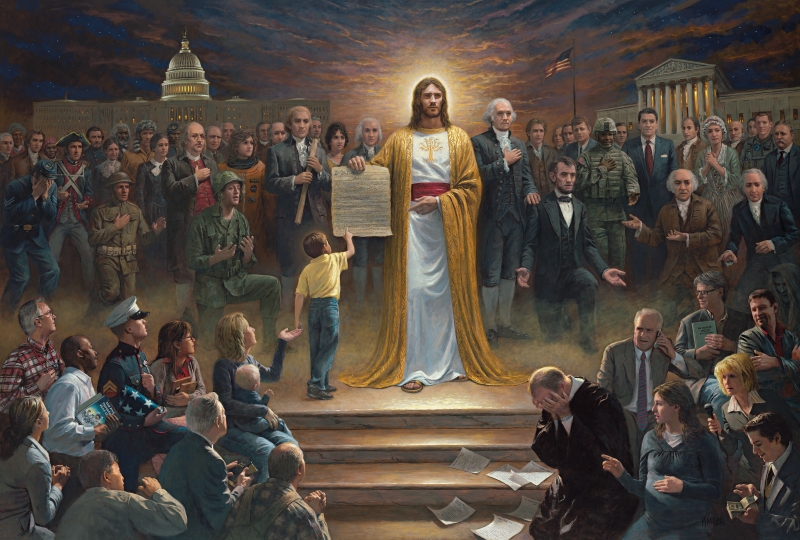
While browsing the gallery I came across this painting, prominently displayed, by Utah-based painter Jon McNaughton:

Initially I just laughed at what I considered a simplistic, oh-so-Utah expression of religion-cum-patriotism, appropriately rendered in the artless schlock of Thomas Kinkade. As I looked closer and realized the specificity of the artist's "message", however, my emotions began to vacillate between acute annoyance and a long-shot hope that this thing might be a marvelously subtle joke.

Sadly, McNaughton earns no points for irony. His painting may look like an exercise in self-caricature, but the humor is unintentional. That you might understand my frustration—and that I might blow off a little steam—allow me to turn my trained artistic eye on this painting and provide a critical exposition.

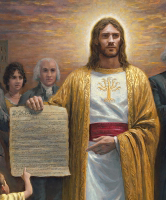
The central focus of the painting is Jesus Christ holding the U. S. Constitution up to the world.
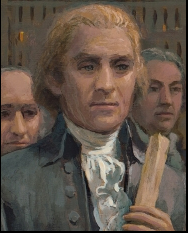
This makes sense because Jesus actually wrote the Constitution and revealed it to the founding fathers—devout Christian men like Benjamin Franklin, Thomas Paine, and Thomas Jefferson.
Divine authorship of our Constitution is the main reason that the U. S. is the best country of all the countries. So it's important that we immortalize that in our art.

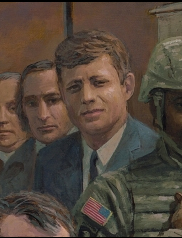
Along with the requisite historical figures flanking the Author and Finisher of our Constitution, there are a few "modern" presidents whose presence is worth mentioning. Obviously Ronald Reagan, who by construction was the most benevolently badass President, supports Jesus and His pro-American agenda. Curiously, however, JFK is also represented among the Constitutional vanguard. As the only righteous representative of American liberalism, his inclusion can only be explained by his willingness to kill godless Communists.


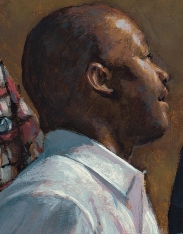
The lower half of the painting is given over to a depiction of the modern American public, divided into two groups who, significantly, are on the right- and left-hand sides of Jesus. On His right hand, obviously, are the ordinary, decent Americans who Believe in and Uphold the Constitution. Their simple patriotism is rendered in stereotype: there's a soldier in uniform, a mother with child in arms, and a simple, working-class man in plaid and overalls.

In a laudable effort at racial inclusion, a lone black man is counted among the righteous—presumably because he's got his copy of Skousen in hand. (Non-LDS readers should be advised that W. Cleon Skousen was an influential LDS author in the 50s and 60s, writing on both political and religious topics. Whatever his other accomplishments, politically he was a conspiracy-theoretic crank. To wit: Glenn Beck has recently promoted his books in an ill-conceived effort at instigating a Skousian renaissance.)

Finally, we have a school teacher, who reminds us that education is an acceptable vocation among the righteous, but only if you restrict yourself to no further than secondary education and appear as mousy as possible while actually in the act of teaching.

On His left hand are the wicked, unpatriotic individuals whose nation-hating nature is indicated by their association with The Devil Himself!

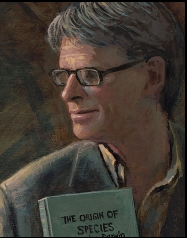
Most of the evil are easy to identify. The secular scientist looks smugly down on the proceedings through trendy rectangular frames, his arrogance and godlessness manifest in the way he clutches his copy of Darwin's Origin of Species. (Never mind that over 100 yeas ago Darwinian evolution was officially declared to be compatible with LDS doctrine, or that modern evolutionary synthesis is taught as a matter of course in BYU biology classes.)

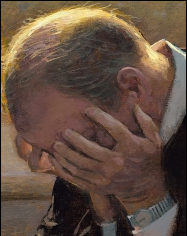
The activist judge buries his face in despair, realizing that Jesus is here to save the Constitution by eradicating his evil, liberal rulings (including Marbury v. Madison, which set the precedent for judicial review; I wonder what McNaughton thinks of Brown v. Board of Education?).

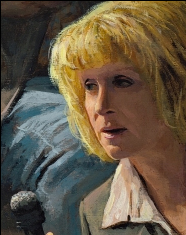
Others are harder to puzzle out. I suppose the microphone-toting blonde is an agent of the MSM, peddling her liberal propaganda to a populace of proletarian sheeple? It's hard to say.

It's even harder to guess at the money-counting businessman or the near-to-bursting pregnant woman. Their politics seem ambiguous at worst and Jesus-friendly at best. Why are they condemned to kick it with The Devil Himself?


All sarcasm aside, this painting is beyond absurd; it's odious. It seeks to legitimize a narrow, nasty, and monolithic ideology—one that rewrites history, cheapens patriotism, and demonizes disagreement—under the guise of fine art. It's an affront to any who believe that the LDS faith comes with no political strings attached, that Mormonism neither prescribes nor proscribes any political platform. It's discouraging enough that this sort of painting generates enough demand to keep McNaughton's studio solvent; that it's popular enough to be featured at an educational institution is pathetic.

It has been famously asked why the LDS community, while over-represented in business, law, and politics, produces so few great artists. I believe the answer is bound up in the kind of art the LDS community wants to consume, which, based on the preceding, isn't very good. Art challenges, is subtle, is occasionally subversive or controversial. And the rank-and-file LDS community isn't interested in controversy or subtlety, but in consuming media that brazenly reinforces its worldview. So for every Orson Scott Card, Minerva Teichert, or even Arnold Friberg (who managed a much more tasteful synthesis of spirituality and patriotism), there are dozens of Stephanie Meyers, Janice Kapp Perrys, and Michael McLeans. Jon McNaughton is merely a particularly egregious example of the countless LDS artists whose work does not inspire, but ploddingly reinforces stale, suffocating orthodoxy.

And that isn't art. It's kitsch. It's the opposite of art. It destroys art. It destroys souls.

[PS: It turns out you can read McNaughton's interpretation of the painting, as well as his response to "liberal" criticism. I think you will find his rhetorical chops exactly commensurate with his artistry!]

Wednesday, March 31, 2010

The excluded middle

A week ago I posted a link to this article, written by David Frum, to my Facebook profile. There are parts of his analysis that I disagree with, of course, but on balance I found the article to be a thoughtful, constructive, and pragmatic take on heathcare reform from a conservative perspective. Most appealingly, Frum didn't engage in the petty histrionics of the tin-foil crowd: his article delightfully misses the entire {'Marxist','bloodless coup','facist','government takeover','armageddon'} set. I was impressed enough to check out his blog, where I found a collection of interesting, articulate political pieces written from a more-or-less conservative perspective. I also found a relatively intelligent commentariat who, in spite of ideological differences, manage impressively civil disagreement. I thought to myself that, in an age of Limbaugh, Beck, and Palin, Frum is exactly the sort of thing the political right ought to promote: reasonable, self-critical, even academic arguments for conservative ideas without anti-intellectualism and scorched-earth demagoguery.

Alas, it was too good to be true. On Tuesday, two days after the publication of the linked piece above, Frum was fired from his position at the conservative American Enterprise Institute.

I won't lie: I was really angry when I found out about it. Of course I can't say whether or not Frum was fired over his politics (if you like you can read his take as well as that of one of his AEI colleagues), but in any case it's disheartening when a political group rejects its moderate elements. People like to complain about the hulking inagility of the two-party system, but one of its chief benefits is that it discourages extremism. Radical ideas are first taken up by third parties, and if they become sufficiently mainstream they are picked up by one of the major parties. This forces the ideas through an incubation period, moderating them before they have any chance at becoming policy. This system works relatively well because the major parties have incentive to appeal to as large a base as possible. Empty political slogans or not, Reagan's big tent, Clinton's third way, and even Bush's compassionate conservatism sought common ground among an ideologically diverse electorate, thereby forcing moderation on the relevant party.

But this system doesn't work if a party caters to its extreme elements. If it continues to pander to the tea party bloc and push out moderates like Frum, the Republican party will give its stupidest and most reactionary elements control over its agenda, which is bad for everybody involved. Energizing a narrow, vocal portion of the base may garner short-term political capital, but it's a losing strategy in the long-term—one that poisons the political atmosphere in the meantime. White-hot partisan noise deepens divides while alienating moderate voters, and it takes more than angry paranoiacs to win elections.

My own politics are a hodgepodge of left- and right-leaning ambivalences, but my loyalties are beside the point: regardless of the party in power, we need a strong, moderating opposition. But when the opposition chooses downtown Glennbeckistan as its ideological epicenter, it relinquishes its claims to credibility and does real damage to democracy.

Sunday, April 19, 2009

The state secedes

Yes, yes, yes. I know. It's been "a while". I'm sure you've all missed me. I have excuses: research qualifiers, paper reviews and revisions, recruitment weekend, composition projects, and a well-connected Finnish engineer have all distracted me from serving up rhetorical goodness for my (four or so) devoted fans.

I started a few posts--one on the tragedy of fading memory as it relates to William Goldman's "The Princess Bride" and one on an unfortunate quote by the otherwise-brilliant Bertrand Russell--but I didn't finish them. Those were shaping up to be complicated posts, and it takes me a lot of effort to organize and articulate my thoughts correctly. So, in keeping with my Gaussian approach to this blog, I've scrapped them--at least for the time being.

But today's topic is perfect for the blogger in a hurry. It's stupid, it makes me angry, and it requires only a minimum of analytical horsepower: Texas secession and the anti-tax tea parties.

On Wednesday, while at a tea party rally in Austin, Texas Governor Rick Perry suggested that if the Federal government didn't start listening to the American people, secession was a real possibility: "We've got a great union. There's absolutely no reason to dissolve it. But if Washington continues to thumb their nose at the American people, you know, who knows what might come out of that."

First, let's get one thing straight. Texas has no special "secession clause" built into its constitution or treaty of annexation. (Even crackpot secessionists admit this.) It's as mythological as the idea that Texas's state flag is uniquely allowed to be flown at the same height as the U. S. flag (in fact, ANY state flag can be flown at the same height. Perhaps Texas is the only state insecure enough to feel the need.) Texas is no more allowed to peaceably secede than any other state, and that question was settled about twenty years after Texas joined the union.

There's a lot to pick on here: the irresponsibility of a standing governor publicly (even if hypothetically) suggesting secession, the obvious hypocrisy of waving an American flag while calling out for secession, and the absurdity of invoking the Boston Tea Party when you have elected officials in Congress. But this article covers those issues, so I'll leave them alone.

Instead, I want to make a different point, which is one of timing. Why are people suddenly so outraged over governmental excess? We've been engaged in "unsustainable" government spending for several years now, and no one complained nearly this loudly. The primary difference is that now there's a good (although perhaps debatable, but still: most credible economists [sorry, Ron Paul, you don't count] agree that SOME sort of stimulus was necessary) reason for it.

So I'm forced to conclude that a "secondary" difference is the real reason for all the protesting: there's a Democrat in the White House instead of a Republican. In other words, this is mostly an exercise in mob-driven partisanship. Hard-core conservatives are hell-bent on complaining about the new administration, so they decide to rekindle their rage over something that didn't get them all that upset a year ago.

It's frustrating for me as a (nominal) conservative, because it's becoming increasingly difficult to take conservative leadership seriously unless you're a party loyalist (which I'm not). This sort of redneck populism has all the intellectual honesty of an NRA pamphlet, and it appeals to roughly the same audience. Unless their goal is to shore up political capital in the former confederacy, encouraging people to "tea bag" Obama isn't exactly a winning strategy.

Of course, if that is their goal, I guess it works out pretty well for them if the secession movement takes hold. It'll simplify the problem of choosing a presidential candidate.

Who knows what might come out of that?

Tuesday, January 20, 2009

Inaugural thoughts

Somehow, Rice is a little more liberal than college campuses that I'm used to, and many classes were rearranged for today's inauguration, which lots of people watched on campus. I joined them, and I'm glad I did. And while I'm surely entering blog-cliche-land by doing this, here are a few scattered thoughts:

I enjoyed the quartet performed just before the oath of office. I rarely think of John Williams as a great composer, even for films (he's tall on simple, brassy bombast and short on subtlety; for my film-scoring money, Thomas Newman is your man), and I'm required as a cellist to remind you that Yo-Yo Ma is overrated (but I like him anyways: he's a superb--but probably not the greatest--classical cellist, and I appreciate his efforts to transcend genres and spread awareness of great music). Other than the fact that the clarinet part seemed to exist only to channel (or rip off) Aaron Copland, it was a great little piece that perfectly matched the tone of the inauguration. It was somber and occasionally dissonant, it had the (again) Copland-esque wide-openness that's uniquely American, and it had moments of genuinely exciting intricacy (right after the clarinet introduces the "Simple Gifts" theme). I was pleasantly surprised, and they did well to class it up after Aretha Franklin's over-divaed "My Country 'Tis of Thee".

I was bothered by commentators' frequent attemps to turn Obama's election into the culmination of the civil rights movement. I doubt that anyone honestly believes that Obama's election marks the eradication of our nation's racial difficulties, and conversely I don't think the goal of the civil rights movement has ever been to elect a black president. I realize that his victory is an important token of how far things have progressed, and I think it's entirely appropriate that the inauguration should occur the day after MLK day, but it's simply inaccurate to speak as though the problem is finally solved.

If you watched the inauguration, you probably noticed that Obama and John Roberts stumbled a bit on the oath of office. I did a little digging, comparing the transcript of what was spoken to the oath as specified in the Constitution. It appears that Roberts made the initial error and prompted Obama incorrectly, tripping Obama up (perhaps he recognized the mistake; he's likely been looking forward to taking the oath for a while) until Roberts corrected the mistake. Interestingly, though, Obama eventually repeated the first (and incorrect) prompt given to him. So if you're starving for another constitutional conspiracy theory to throw at the president, you can complain that he never properly took the oath of office...

And that brings me to my last point:

I'm optimistic about Obama's presidency. I didn't vote for Obama, and he almost certainly will enact policies that I disagree with, but I've spent time sticking up for him among conservatives. Maybe I've been brainwashed by all the Facebook and the YouTube and the Google, but I think the goodwill we've seen towards him is well-founded. I believe he is both intelligent and intellectually honest: despite his far-left record, he's shown moderation, pragmatism, and a cool head since his election, hardly the hallmark of a closed-minded ideologue. I believe that his bipartisanship is more than lofty rhetoric: he has repeatedly sought the advice of his rivals. And I've come around to the idea that these principles--intellectual honesty, restraint, and moderation--are more important than ideological compatibility. The time for shrill cries of "terrorist" and "radical socialist" is over and, in all honesty, never was here. The incoming administration will undoubtedly have its deep flaws, but it's been a long time since we've had the opportunity to let ideological loyalties take a secondary role and unite in optimism for our nation. Maybe we'll end up disappointed by yet another career politician whose campaign message was only rhetoric. But I think that now's a unique opportunity to take a chance, give the benefit of the doubt, and offer hope for the country.

Thursday, January 1, 2009

Dumb enough to think it's important

Whatever my shortcomings, I'm an honest person. Honest to a fault, perhaps. I'm usually undiplomatically blunt, flattery makes me uncomfortable, and I'm awkward when social circumstances prevent me from speaking my mind directly. But, for all its drawbacks, I'm passionate about honesty, particularly intellectual honesty. By that I mean that a person should admit his biases, honestly strive to understand and appreciate opposing arguments, and readily acknowledge that he is often wrong. Intellectual honesty is an honesty with oneself, an aim that should supersede ideological loyalties and personal allegiances. Anything less diminishes our epistemological autonomy, which is (I submit) the fundamental ingredient of being human.

As a result, I hate the assumption--which is nearly ubiquitous in political debate--that your opponent disagrees with you because he is uninformed, deceived, or somehow morally deficient. It's the nasty stuff of partisanship. It drives the meta-partisan venom of Ann Coulter and the shrill pedantry of Keith Olbermann. It leads a person to believe that his party is the party of facts and logic and the lone defender of goodness and decency. It makes us believe that if only our opponents were a little smarter or had our possession of the facts, they would obviously agree with us. It reinforces the idea that political opponents are the enemy, encouraging a person to describe his opponents in cheap caricature: Republicans are portrayed as selfish rednecks while Democrats become lazy entitlement-seekers.

I find such a mindset more harmful than just about any political position. It encourages divisiveness and prevents us from understanding one another. But it also obscures one of the few reliable truths in politics: everything, no matter how well thought out, has its downside. Nearly all political positions involve a compromise of principles.

At its best, socialism (I use the term loosely, both for simplicity and to dilute the stigma unfairly attached to it) encourages compassion, protects the disadvantaged, and discourages materialism. At its worst, it promotes laziness and mediocrity. I think that's precisely why artists, writers, and academics typically lean left. It's not because they're naive or don't live in the 'real world' (whatever the hell that means). It's because--as evidenced by their career choices--they're motivated by something other than material gain.

At its best, capitalism (again, used loosely for similar reasons) promotes self-reliance, industry, and the value of excellence. At its worst, it promotes greed, selfishness, and the exploitation of the weak. That's why businessmen and entrepreneurs tend to lean right. It's not fair to assume that they're too selfish to care about the disadvantaged. Instead, they think financial reward is the best possible incentive to help people realize noble ambitions.

(Of course I'm being a little too nice. I'm aware that there do exist troglodytic conservatives and dole-bludging liberals. But the point is that it's better to assume good faith than to uniformly paint your opponents with a caricatured brush.)

Personally, I tend to lean right, especially on fiscal matters. But I'm not trying advocate a particular ideology, even mine. Instead, the point I want to bring home is that a person can be just as smart, decent, and well-informed as you and still espouse an entirely different political ideology. I do believe in absolute truth. I just don't think we encounter it very often. And almost surely we do not encounter it in the political arena.