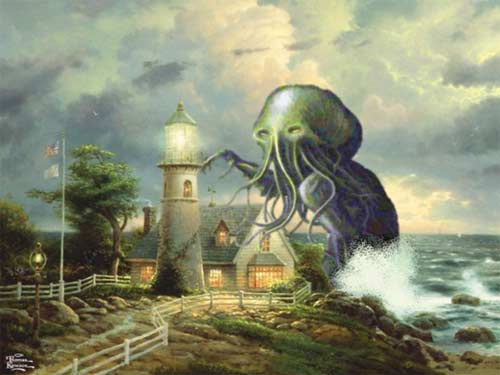
On my twenty-sixth birthday, I joked that I was "pushing thirty". It was a casual, throwaway technicality, designed to poke fun at the neuroses of those nearer to the mark, borne of an arrogance only possible because my own senescence was a hypothetical whose realization I had never confronted. Now, scant years later I am, unequivocally, pushing thirty. No longer merely discernible on the horizon, it hurtles toward me (or I toward it) relentlessly, and I—fattening, incipiently balding, cognitively ossifying—scrabble for handholds as my horizontal trajectory tilts savagely to vertical, seeing not only the mark but the headlong path beyond it, hanging momentarily weightless at the precipice as fear and anxiety are swallowed up in a single, overriding despair:
I don't want to die.
Sunday, July 18, 2010
Pushing
Written last week during a fit of insomnia, and delivered against my better judgement into the cruel hands of the internet:

Sunday, July 11, 2010
Meta-post: Rebranded
You hopefully notice that the blog has a new look. I worked at a web design company during undergrad, and after the successful redesign of my ECE webpage and Amanda's now-mostly-photo blog, I decided to apply my vestigial skills to these humble pages. It turns out that Blogger really doesn't want you to design your own template; they'd rather have you use one of their prefab designs. But after wrestling Blogger to the floor and putting it in a half-nelson, my custom design emerges victorious.
I hope you like the new design—I stole from a lot of good pages to put it together! After a year or so of resisting it, I finally incorporated the "lowercase" idea (which was never intended as a pun; "lowercase profanity" refers to mild swearing, the kind a good Mormon boy might use when he gets upset) into the template. I've tested everything out on a few different browsers, but if anyone notices any layout issues I'd be grateful to hear about them.
On an unrelated note, I've decided to de-list this blog from Google Buzz. Most of those following me are co-workers/collegues, and I'd prefer to have the freedom to write whatever I like without worrying about the fact that I'm explicitly broadcasting it to the ECE department. Everyone is welcome and encouraged to follow (and comment at!) this blog, but I'd rather not deliver it to everyone's inbox. It feels too exhibitionistic to me. I hope that many of you will still keep up with it. That'd be real swell.
I hope you like the new design—I stole from a lot of good pages to put it together! After a year or so of resisting it, I finally incorporated the "lowercase" idea (which was never intended as a pun; "lowercase profanity" refers to mild swearing, the kind a good Mormon boy might use when he gets upset) into the template. I've tested everything out on a few different browsers, but if anyone notices any layout issues I'd be grateful to hear about them.
On an unrelated note, I've decided to de-list this blog from Google Buzz. Most of those following me are co-workers/collegues, and I'd prefer to have the freedom to write whatever I like without worrying about the fact that I'm explicitly broadcasting it to the ECE department. Everyone is welcome and encouraged to follow (and comment at!) this blog, but I'd rather not deliver it to everyone's inbox. It feels too exhibitionistic to me. I hope that many of you will still keep up with it. That'd be real swell.
Thursday, June 24, 2010
The best art of all the art
We're in Utah this week, attending my sister's wedding and hoping to see some old friends while we're here. We moved away from Provo nearly two years ago, and I'm surprised to find just how nice it is to be back. Not only are the surroundings much, much more beautiful than anything Houston has to offer, but Provo also has a bright, cheerful air that I both admire and miss. Fueled as it may be by equal parts naïveté and self-delusion, Provo's happy-go-lucky optimism makes me feel at home in a way I never could have anticipated while I lived here.
Reconnecting with our Utah roots, Amanda and I wandered around BYU campus for a few hours, eating lunch at the Cougareat, visiting old classroom halls, and eventually perusing the BYU bookstore. In addition to the usual university bookstore fare—hats, T-shirts, and textbooks—there's also a candy store, a floral shop, and a gallery where you can purchase art frames and (mostly LDS-themed) paintings.
You can also purchase terrible, terrible shit.
While browsing the gallery I came across this painting, prominently displayed, by Utah-based painter Jon McNaughton:
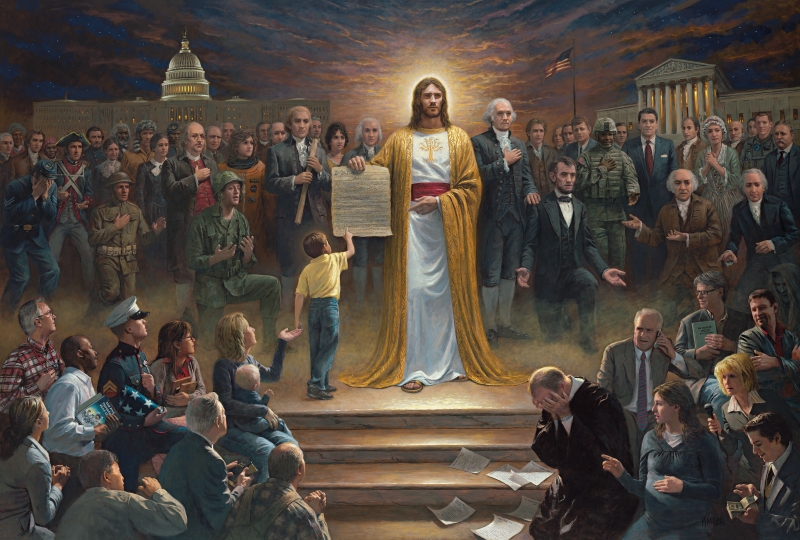
Initially I just laughed at what I considered a simplistic, oh-so-Utah expression of religion-cum-patriotism, appropriately rendered in the artless schlock of Thomas Kinkade. As I looked closer and realized the specificity of the artist's "message", however, my emotions began to vacillate between acute annoyance and a long-shot hope that this thing might be a marvelously subtle joke.
Sadly, McNaughton earns no points for irony. His painting may look like an exercise in self-caricature, but the humor is unintentional. That you might understand my frustration—and that I might blow off a little steam—allow me to turn my trained artistic eye on this painting and provide a critical exposition.
The central focus of the painting is Jesus Christ holding the U. S. Constitution up to the world.
 This makes sense because Jesus actually wrote the Constitution and revealed it to the founding fathers—devout Christian men like Benjamin Franklin, Thomas Paine, and Thomas Jefferson.
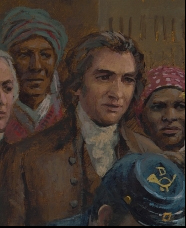
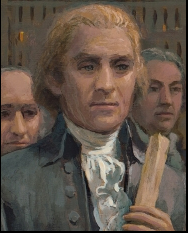 Divine authorship of our Constitution is the main reason that the U. S. is the best country of all the countries. So it's important that we immortalize that in our art.
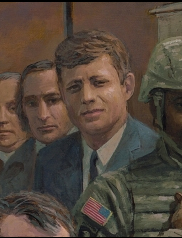
Along with the requisite historical figures flanking the Author and Finisher of our Constitution, there are a few "modern" presidents whose presence is worth mentioning. Obviously Ronald Reagan, who by construction was the most benevolently badass President, supports Jesus and His pro-American agenda. Curiously, however, JFK is also represented among the Constitutional vanguard. As the only righteous representative of American liberalism, his inclusion can only be explained by his willingness to kill godless Communists.

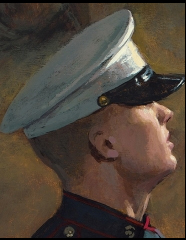
The lower half of the painting is given over to a depiction of the modern American public, divided into two groups who, significantly, are on the right- and left-hand sides of Jesus. On His right hand, obviously, are the ordinary, decent Americans who Believe in and Uphold the Constitution. Their simple patriotism is rendered in stereotype: there's a soldier in uniform, a mother with child in arms, and a simple, working-class man in plaid and overalls.


In a laudable effort at racial inclusion, a lone black man is counted among the righteous—presumably because he's got his copy of Skousen in hand. (Non-LDS readers should be advised that W. Cleon Skousen was an influential LDS author in the 50s and 60s, writing on both political and religious topics. Whatever his other accomplishments, politically he was a conspiracy-theoretic crank. To wit: Glenn Beck has recently promoted his books in an ill-conceived effort at instigating a Skousian renaissance.)
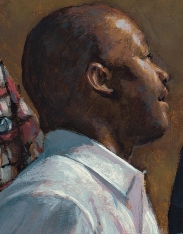
Finally, we have a school teacher, who reminds us that education is an acceptable vocation among the righteous, but only if you restrict yourself to no further than secondary education and appear as mousy as possible while actually in the act of teaching.

On His left hand are the wicked, unpatriotic individuals whose nation-hating nature is indicated by their association with The Devil Himself!

Most of the evil are easy to identify. The secular scientist looks smugly down on the proceedings through trendy rectangular frames, his arrogance and godlessness manifest in the way he clutches his copy of Darwin's Origin of Species. (Never mind that over 100 yeas ago Darwinian evolution was officially declared to be compatible with LDS doctrine, or that modern evolutionary synthesis is taught as a matter of course in BYU biology classes.)

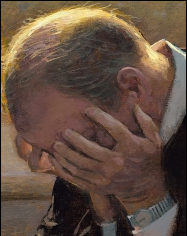
The activist judge buries his face in despair, realizing that Jesus is here to save the Constitution by eradicating his evil, liberal rulings (including Marbury v. Madison, which set the precedent for judicial review; I wonder what McNaughton thinks of Brown v. Board of Education?).
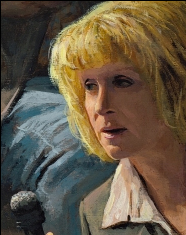
Others are harder to puzzle out. I suppose the microphone-toting blonde is an agent of the MSM, peddling her liberal propaganda to a populace of proletarian sheeple? It's hard to say.
It's even harder to guess at the money-counting businessman or the near-to-bursting pregnant woman. Their politics seem ambiguous at worst and Jesus-friendly at best. Why are they condemned to kick it with The Devil Himself?


All sarcasm aside, this painting is beyond absurd; it's odious. It seeks to legitimize a narrow, nasty, and monolithic ideology—one that rewrites history, cheapens patriotism, and demonizes disagreement—under the guise of fine art. It's an affront to any who believe that the LDS faith comes with no political strings attached, that Mormonism neither prescribes nor proscribes any political platform. It's discouraging enough that this sort of painting generates enough demand to keep McNaughton's studio solvent; that it's popular enough to be featured at an educational institution is pathetic.
It has been famously asked why the LDS community, while over-represented in business, law, and politics, produces so few great artists. I believe the answer is bound up in the kind of art the LDS community wants to consume, which, based on the preceding, isn't very good. Art challenges, is subtle, is occasionally subversive or controversial. And the rank-and-file LDS community isn't interested in controversy or subtlety, but in consuming media that brazenly reinforces its worldview. So for every Orson Scott Card, Minerva Teichert, or even Arnold Friberg (who managed a much more tasteful synthesis of spirituality and patriotism), there are dozens of Stephanie Meyers, Janice Kapp Perrys, and Michael McLeans. Jon McNaughton is merely a particularly egregious example of the countless LDS artists whose work does not inspire, but ploddingly reinforces stale, suffocating orthodoxy.
And that isn't art. It's kitsch. It's the opposite of art. It destroys art. It destroys souls.
[PS: It turns out you can read McNaughton's interpretation of the painting, as well as his response to "liberal" criticism. I think you will find his rhetorical chops exactly commensurate with his artistry!]
Reconnecting with our Utah roots, Amanda and I wandered around BYU campus for a few hours, eating lunch at the Cougareat, visiting old classroom halls, and eventually perusing the BYU bookstore. In addition to the usual university bookstore fare—hats, T-shirts, and textbooks—there's also a candy store, a floral shop, and a gallery where you can purchase art frames and (mostly LDS-themed) paintings.
You can also purchase terrible, terrible shit.
While browsing the gallery I came across this painting, prominently displayed, by Utah-based painter Jon McNaughton:
Initially I just laughed at what I considered a simplistic, oh-so-Utah expression of religion-cum-patriotism, appropriately rendered in the artless schlock of Thomas Kinkade. As I looked closer and realized the specificity of the artist's "message", however, my emotions began to vacillate between acute annoyance and a long-shot hope that this thing might be a marvelously subtle joke.
Sadly, McNaughton earns no points for irony. His painting may look like an exercise in self-caricature, but the humor is unintentional. That you might understand my frustration—and that I might blow off a little steam—allow me to turn my trained artistic eye on this painting and provide a critical exposition.
The central focus of the painting is Jesus Christ holding the U. S. Constitution up to the world.
Along with the requisite historical figures flanking the Author and Finisher of our Constitution, there are a few "modern" presidents whose presence is worth mentioning. Obviously Ronald Reagan, who by construction was the most benevolently badass President, supports Jesus and His pro-American agenda. Curiously, however, JFK is also represented among the Constitutional vanguard. As the only righteous representative of American liberalism, his inclusion can only be explained by his willingness to kill godless Communists.
The lower half of the painting is given over to a depiction of the modern American public, divided into two groups who, significantly, are on the right- and left-hand sides of Jesus. On His right hand, obviously, are the ordinary, decent Americans who Believe in and Uphold the Constitution. Their simple patriotism is rendered in stereotype: there's a soldier in uniform, a mother with child in arms, and a simple, working-class man in plaid and overalls.
On His left hand are the wicked, unpatriotic individuals whose nation-hating nature is indicated by their association with The Devil Himself!
All sarcasm aside, this painting is beyond absurd; it's odious. It seeks to legitimize a narrow, nasty, and monolithic ideology—one that rewrites history, cheapens patriotism, and demonizes disagreement—under the guise of fine art. It's an affront to any who believe that the LDS faith comes with no political strings attached, that Mormonism neither prescribes nor proscribes any political platform. It's discouraging enough that this sort of painting generates enough demand to keep McNaughton's studio solvent; that it's popular enough to be featured at an educational institution is pathetic.
It has been famously asked why the LDS community, while over-represented in business, law, and politics, produces so few great artists. I believe the answer is bound up in the kind of art the LDS community wants to consume, which, based on the preceding, isn't very good. Art challenges, is subtle, is occasionally subversive or controversial. And the rank-and-file LDS community isn't interested in controversy or subtlety, but in consuming media that brazenly reinforces its worldview. So for every Orson Scott Card, Minerva Teichert, or even Arnold Friberg (who managed a much more tasteful synthesis of spirituality and patriotism), there are dozens of Stephanie Meyers, Janice Kapp Perrys, and Michael McLeans. Jon McNaughton is merely a particularly egregious example of the countless LDS artists whose work does not inspire, but ploddingly reinforces stale, suffocating orthodoxy.
And that isn't art. It's kitsch. It's the opposite of art. It destroys art. It destroys souls.
[PS: It turns out you can read McNaughton's interpretation of the painting, as well as his response to "liberal" criticism. I think you will find his rhetorical chops exactly commensurate with his artistry!]
Friday, June 11, 2010
In me you trust
A quick observation:
Over the last twelve months I've climbed six full rungs up the ladder of facial hair trustworthiness, which places me ahead of Abe Lincoln, Wilford Brimley, and Aristotle. I suggest you all take a moment to celebrate me and my meaningful achievements!

(Image credit goes to Matt McInerney, and thanks go to David Malki ! of Wondermark for sharing the image with the beard-going public.)
Over the last twelve months I've climbed six full rungs up the ladder of facial hair trustworthiness, which places me ahead of Abe Lincoln, Wilford Brimley, and Aristotle. I suggest you all take a moment to celebrate me and my meaningful achievements!

(Image credit goes to Matt McInerney, and thanks go to David Malki ! of Wondermark for sharing the image with the beard-going public.)
Sunday, May 2, 2010
Fist of fury
Sometimes I just want to punch people in the face.
Let me emphasize that this is a new feeling for me. I've never been a physically violent or even hot-tempered person. I never got into a fight in school—not because I was afraid of getting beat up (although that's very likely what would have happened), but because it isn't in my nature. I DO like to argue, as everyone reading this must already know, so I don't shy away from conflict, but typically in an argument my emotions remain in check. I've always felt that arguments come to blows only when people are either too stupid or too cowardly to articulate their ideas verbally. In other words, people resort to violence only when their words are impotent. Turns out I'm a fan of neither stupidity nor cowardice, and I'm certainly not cheering for verbal impotence, so you'd expect anger management to come to me naturally. And usually it does.
But sometimes I still want to punch people in the face.
Not very often, of course. It's actually a very specific set of circumstances that boil my blood, and I've spent a reasonable amount of time trying to figure out exactly why they set me off when ordinarily it's not in my nature. I found common thread: arguments in which I've gone to considerable effort to explain myself, yet the other person almost deliberately refuses to understand me. In these arguments, my words are involuntarily rendered impotent—not because I can't articulate myself, but because I'm dealing with someone who has already deemed unimportant something he doesn't care to understand.
In some ways my frustration is probably obvious and commonplace—no one likes to have their hard work casually tossed aside—but for me it's more personal and not at all trivial. In all my interpersonal interactions—with my wife, family, friends, colleagues, whatever—my overwhelmingly top priority is to be understood. Not to be praised or to dominate or to be the smartest, not even to be comforted or loved, but to be understood. That's why I love to teach, why I sincerely appreciate it when people dissent on this blog, and particularly why I enjoy arguing. Done properly, disagreement gives me an opportunity both to understand someone else and to be understood. THAT is the miracle of human interaction—that after hours of discussion two friends arguing over dinner can breach the lonely barrier of solipsism and arrive at a mutually edifying mutual understanding. For me it's the only really authentic way of connecting with another person: through his ideas. Everything else is superficial by comparison. So when you stomp on that connection because you're too busy pushing your agenda, defending your pride, or just being angry simply because I disagree with you, you stomp on an innate part of me, and you deny me the only meaningful way I have to connect with you.
And when that happens, don't get angry if I want to punch you in the face. Maybe you deserve it.
Let me emphasize that this is a new feeling for me. I've never been a physically violent or even hot-tempered person. I never got into a fight in school—not because I was afraid of getting beat up (although that's very likely what would have happened), but because it isn't in my nature. I DO like to argue, as everyone reading this must already know, so I don't shy away from conflict, but typically in an argument my emotions remain in check. I've always felt that arguments come to blows only when people are either too stupid or too cowardly to articulate their ideas verbally. In other words, people resort to violence only when their words are impotent. Turns out I'm a fan of neither stupidity nor cowardice, and I'm certainly not cheering for verbal impotence, so you'd expect anger management to come to me naturally. And usually it does.
But sometimes I still want to punch people in the face.
Not very often, of course. It's actually a very specific set of circumstances that boil my blood, and I've spent a reasonable amount of time trying to figure out exactly why they set me off when ordinarily it's not in my nature. I found common thread: arguments in which I've gone to considerable effort to explain myself, yet the other person almost deliberately refuses to understand me. In these arguments, my words are involuntarily rendered impotent—not because I can't articulate myself, but because I'm dealing with someone who has already deemed unimportant something he doesn't care to understand.
In some ways my frustration is probably obvious and commonplace—no one likes to have their hard work casually tossed aside—but for me it's more personal and not at all trivial. In all my interpersonal interactions—with my wife, family, friends, colleagues, whatever—my overwhelmingly top priority is to be understood. Not to be praised or to dominate or to be the smartest, not even to be comforted or loved, but to be understood. That's why I love to teach, why I sincerely appreciate it when people dissent on this blog, and particularly why I enjoy arguing. Done properly, disagreement gives me an opportunity both to understand someone else and to be understood. THAT is the miracle of human interaction—that after hours of discussion two friends arguing over dinner can breach the lonely barrier of solipsism and arrive at a mutually edifying mutual understanding. For me it's the only really authentic way of connecting with another person: through his ideas. Everything else is superficial by comparison. So when you stomp on that connection because you're too busy pushing your agenda, defending your pride, or just being angry simply because I disagree with you, you stomp on an innate part of me, and you deny me the only meaningful way I have to connect with you.
And when that happens, don't get angry if I want to punch you in the face. Maybe you deserve it.
Wednesday, March 31, 2010
The excluded middle
A week ago I posted a link to this article, written by David Frum, to my Facebook profile. There are parts of his analysis that I disagree with, of course, but on balance I found the article to be a thoughtful, constructive, and pragmatic take on heathcare reform from a conservative perspective. Most appealingly, Frum didn't engage in the petty histrionics of the tin-foil crowd: his article delightfully misses the entire {'Marxist','bloodless coup','facist','government takeover','armageddon'} set. I was impressed enough to check out his blog, where I found a collection of interesting, articulate political pieces written from a more-or-less conservative perspective. I also found a relatively intelligent commentariat who, in spite of ideological differences, manage impressively civil disagreement. I thought to myself that, in an age of Limbaugh, Beck, and Palin, Frum is exactly the sort of thing the political right ought to promote: reasonable, self-critical, even academic arguments for conservative ideas without anti-intellectualism and scorched-earth demagoguery.
Alas, it was too good to be true. On Tuesday, two days after the publication of the linked piece above, Frum was fired from his position at the conservative American Enterprise Institute.
I won't lie: I was really angry when I found out about it. Of course I can't say whether or not Frum was fired over his politics (if you like you can read his take as well as that of one of his AEI colleagues), but in any case it's disheartening when a political group rejects its moderate elements. People like to complain about the hulking inagility of the two-party system, but one of its chief benefits is that it discourages extremism. Radical ideas are first taken up by third parties, and if they become sufficiently mainstream they are picked up by one of the major parties. This forces the ideas through an incubation period, moderating them before they have any chance at becoming policy. This system works relatively well because the major parties have incentive to appeal to as large a base as possible. Empty political slogans or not, Reagan's big tent, Clinton's third way, and even Bush's compassionate conservatism sought common ground among an ideologically diverse electorate, thereby forcing moderation on the relevant party.
But this system doesn't work if a party caters to its extreme elements. If it continues to pander to the tea party bloc and push out moderates like Frum, the Republican party will give its stupidest and most reactionary elements control over its agenda, which is bad for everybody involved. Energizing a narrow, vocal portion of the base may garner short-term political capital, but it's a losing strategy in the long-term—one that poisons the political atmosphere in the meantime. White-hot partisan noise deepens divides while alienating moderate voters, and it takes more than angry paranoiacs to win elections.
My own politics are a hodgepodge of left- and right-leaning ambivalences, but my loyalties are beside the point: regardless of the party in power, we need a strong, moderating opposition. But when the opposition chooses downtown Glennbeckistan as its ideological epicenter, it relinquishes its claims to credibility and does real damage to democracy.
Alas, it was too good to be true. On Tuesday, two days after the publication of the linked piece above, Frum was fired from his position at the conservative American Enterprise Institute.
I won't lie: I was really angry when I found out about it. Of course I can't say whether or not Frum was fired over his politics (if you like you can read his take as well as that of one of his AEI colleagues), but in any case it's disheartening when a political group rejects its moderate elements. People like to complain about the hulking inagility of the two-party system, but one of its chief benefits is that it discourages extremism. Radical ideas are first taken up by third parties, and if they become sufficiently mainstream they are picked up by one of the major parties. This forces the ideas through an incubation period, moderating them before they have any chance at becoming policy. This system works relatively well because the major parties have incentive to appeal to as large a base as possible. Empty political slogans or not, Reagan's big tent, Clinton's third way, and even Bush's compassionate conservatism sought common ground among an ideologically diverse electorate, thereby forcing moderation on the relevant party.
But this system doesn't work if a party caters to its extreme elements. If it continues to pander to the tea party bloc and push out moderates like Frum, the Republican party will give its stupidest and most reactionary elements control over its agenda, which is bad for everybody involved. Energizing a narrow, vocal portion of the base may garner short-term political capital, but it's a losing strategy in the long-term—one that poisons the political atmosphere in the meantime. White-hot partisan noise deepens divides while alienating moderate voters, and it takes more than angry paranoiacs to win elections.
My own politics are a hodgepodge of left- and right-leaning ambivalences, but my loyalties are beside the point: regardless of the party in power, we need a strong, moderating opposition. But when the opposition chooses downtown Glennbeckistan as its ideological epicenter, it relinquishes its claims to credibility and does real damage to democracy.
Wednesday, March 10, 2010
Here we come a-qwantzling
I've made it no secret on this blog that I love Dinosaur Comics. I find the strip extremely funny—both intellectually and viscerally—in a way that I can't properly explain to people who don't share my appreciation. If you aren't familiar, you should give it a fair hearing. It could change your life for the awesomer.
Ryan North, the writer of Dinosaur Comics, embedded a puzzle in one of his recent comics. Inspired by the cryptographic messages of early modern scientists like Newton and Hooke, he encoded the strip's punchline as an anagram: "12t10o8e7a6l6n6u5i5s5d5h5y3I3r3fbbwwkcmvg", meaning that there are 12 't's, 10 'o's, etc. He left it to his readers to decode the scripts and offered prizes for the first person to return the correct punchline. That was over a week ago.
So far no one has solved it. It's like Excalibur. Or the Riemann hypothesis.
Realizing that his "qwantzle" is challenging, Ryan has been slowly giving out clues. So far, this is all we know:
Even with the clues, qwantzle is maddeningly hard. Naively, there are 97! letter combinations, and even if you incorporate all of the hints the number of possible word combinations is staggering—far too many for a computer to enumerate. So there's a small community of readers working on heuristic approaches to the problem, trying to combine human intuition with brute-force computational strength. But so far, most solutions (interestingly, readers have submitted many grammatical sentences that meet the criteria, but none of them has been correct) have come simply by guess-and-check.
I won't lie: I've spent more time than I care to admit on qwantzle. I've taught myself a new programming language and spent a few idle hours crash-coursing on computational linguistics. To show for it, I've developed two approaches that I thought were clever. One takes a valid solution, randomly deletes a few words, and forms a new anagram with the deleted words; this gives you a way to automatically explore variations on a solution that you think might be pretty close. The other performs a genetic algorithm on letter ordering alone. The letter orderings are ranked according to how well they correlate with DC dialogue, randomly mutated and crossed over, and made to compete in a pseudo-Darwinian process intended to improve the overall quality of the solutions.
But, despite (what I consider) reasonable creativity, these approaches don't work all that well. They WILL spit out technically valid solutions, but they aren't terribly grammatical. My next step should be to include natural language processing techniques—NLP is a new field with surprising success at computationally characterizing language as it is spoken and written—but I'm having a hard time being optimistic. In general, computers are far inferior to human brains at pattern recognition, and I struggle to believe that a computer could be made to recognize the right answer even if it found it.
I'm certainly on the lookout for new solution ideas, of course. But I think that the problem will remain unsolved until Ryan North finally gives out enough clues—at which time it will be solved by a human brain performing (computer-aided) guess-and-check.
[Note: I originally mistyped the anagram, so if any of you were working on the puzzle using my copy—and I hope you weren't—I'm very sorry and it's fixed now!]
Ryan North, the writer of Dinosaur Comics, embedded a puzzle in one of his recent comics. Inspired by the cryptographic messages of early modern scientists like Newton and Hooke, he encoded the strip's punchline as an anagram: "12t10o8e7a6l6n6u5i5s5d5h5y3I3r3fbbwwkcmvg", meaning that there are 12 't's, 10 'o's, etc. He left it to his readers to decode the scripts and offered prizes for the first person to return the correct punchline. That was over a week ago.
So far no one has solved it. It's like Excalibur. Or the Riemann hypothesis.
Realizing that his "qwantzle" is challenging, Ryan has been slowly giving out clues. So far, this is all we know:
- The solution is a single, reasonably grammatical sentence that fits the context of the strip. It begins with the word "I", contains a colon and a comma (in that order), and ends with a double exclamation mark!!
- Letters in the solution are capitalized as in the code, and there are no proper nouns; thus, combined with the first clue, all instances of capital I must be the word "I".
- All words in the solution have been used previously in Dinosaur Comics. (DC is searchable, and readers have put together a dictionary of all possible words. My untrimmed dictionary has 14,000 unique words.)
- The longest word in the puzzle has 11 letters, and the next-longest word has 8; these words appear sequentially in the solution.
- [RN recently posted a final clue: the largest word is 'fundamental'. It helps, I suppose, but I think most people had already guessed that, and in any case the search space is still obscenely large!]
Even with the clues, qwantzle is maddeningly hard. Naively, there are 97! letter combinations, and even if you incorporate all of the hints the number of possible word combinations is staggering—far too many for a computer to enumerate. So there's a small community of readers working on heuristic approaches to the problem, trying to combine human intuition with brute-force computational strength. But so far, most solutions (interestingly, readers have submitted many grammatical sentences that meet the criteria, but none of them has been correct) have come simply by guess-and-check.
I won't lie: I've spent more time than I care to admit on qwantzle. I've taught myself a new programming language and spent a few idle hours crash-coursing on computational linguistics. To show for it, I've developed two approaches that I thought were clever. One takes a valid solution, randomly deletes a few words, and forms a new anagram with the deleted words; this gives you a way to automatically explore variations on a solution that you think might be pretty close. The other performs a genetic algorithm on letter ordering alone. The letter orderings are ranked according to how well they correlate with DC dialogue, randomly mutated and crossed over, and made to compete in a pseudo-Darwinian process intended to improve the overall quality of the solutions.
But, despite (what I consider) reasonable creativity, these approaches don't work all that well. They WILL spit out technically valid solutions, but they aren't terribly grammatical. My next step should be to include natural language processing techniques—NLP is a new field with surprising success at computationally characterizing language as it is spoken and written—but I'm having a hard time being optimistic. In general, computers are far inferior to human brains at pattern recognition, and I struggle to believe that a computer could be made to recognize the right answer even if it found it.
I'm certainly on the lookout for new solution ideas, of course. But I think that the problem will remain unsolved until Ryan North finally gives out enough clues—at which time it will be solved by a human brain performing (computer-aided) guess-and-check.
[Note: I originally mistyped the anagram, so if any of you were working on the puzzle using my copy—and I hope you weren't—I'm very sorry and it's fixed now!]
Subscribe to:
Posts (Atom)

Related Work
-
Temple11 years ago
-
White Dining Table11 years ago
-
school's out forever12 years ago
-
34 for 3413 years ago
-
My New Commitment to a Clean Desk13 years ago
-
becoming a Numerican14 years ago
-
A Noble Knight...14 years ago
-
Peña Nieto y sus libros14 years ago
-
Happiness & Cheer14 years ago
-
Funeral15 years ago
-
Further Portland proof of Fun!15 years ago
-
Long Story Short16 years ago
-
-
-