I gave the following talk at a Mormon Stories conference yesterday here in Houston. Since I haven't posted anything detailed on how I left Mormonism, I thought that some of you might appreciate reading this. The talk was recorded, and the live version is available here.
I’d like to begin with two disclaimers.
First, while I’m the one standing up here and telling the story — and while I’m certainly telling it from my perspective — this is our story. It's a story of how I left Mormonism, how Amanda has remained an active member, and how our relationship has survived in spite of our differences. It’s a story about both of us, in other words. It’s too bad that there isn’t time for both of us to tell our sides of it, and I find it a bit anti-feminist — especially for Mormon Stories! — that I’m the one up here. But here we are. The consolation prize is that we get to break the usual Sacrament Meeting convention: Here it’s the husband who has to introduce the family to the new ward, not the wife!
Second, I don’t want anyone to think we have marriage advice to give out. We know we got off easy: we’re young, we have no kids, and our situation is much less complex than many others'. All I can do is to tell what we’ve been through and to share a few insights that we’ve gleaned along the way. The predictive value of our experiences, or the applicability of our insights to individual circumstances, I’m simply not willing to claim.
With those out of the way, let me lay out my thesis: Stable, healthy marriages between active Mormons and ex-Mormons are possible. New apostates often feel like the only way to save their marriage is to deconvert their spouse. I believe this to be a largely false and harmful idea. I also believe that the shift in worldview that often accompanies a faith crisis gives the apostate two insights that can help stabilize a mixed-faith marriage. One, belief doesn’t have much to do with intelligence. Two, belief doesn’t have much to do with morality.
By Mormon standards, my upbringing was pretty ordinary. I was born in Tacoma, Washington, to parents of pioneer ancestry. Dad worked in business while Mom stayed home with the five kids. We were loyal Republicans. I hit all the usual milestones. I was baptized at 8, ordained to the Aaronic priesthood at 12, and at 18 I graduated from high school and was shipped off to BYU, where I picked a safe, marketable major.
After my freshman year, I put in my papers and was called to the Australia Perth Mission.
I had always believed in Mormonism, and I felt like it held together logically. But I also subscribed to the Mormon epistemology that I could know — through unmistakeable spiritual witness — that it was True. And I’d never had such a witness. So while I left for my mission not “knowing” if the Church was true, I had every expectation of receiving a witness while teaching the gospel. I was not disappointed. In the early months of my mission, during a small handful of our very rare opportunities to teach, I experienced a profound, naked human connection as we testified of the gospel and as our testimonies were received. Even now, as an unbeliever and a thoroughgoing materialist, I consider these experiences meaningful and even transcendental. As an idealistic young missionary hungry for spiritual validation, I considered them an indisputable manifestation of the Holy Spirit. I completed my mission and returned to BYU confident that I knew, not merely believed, and that my faith would endure for the rest of my life.
I was wrong. In fact, my faith endured for only a few years. My faith started its transition as I worked on my master’s degree. I was still at BYU, and I wasn’t studying anything that would challenge a testimony, but the transition from undergraduate study to graduate work has a way of forcing self-skepticism on a person. And that’s because research is difficult and unstructured. Suddenly, instead of being the guy who can master difficult concepts and solve problems on exams, I was the guy suggesting wrong-headed solutions to research problems. I went from being very rarely wrong in my area of expertise to being wrong every single day. And I came to learn that this was perfectly normal. Being wrong was part of the program. The first of my two insights began to set in: When the questions are hard, even smart people are wrong all the time. Belief has little to do with intelligence.
Around this time I met Amanda. Her upbringing was less stereotypically Mormon than mine. She grew up in Dallas. Her parents had converted to Mormonism in the mid 70s. By Mormon standards they were politically left-of-center. In their household, belief in evolution did not contradict belief in Mormonism. Gays and lesbians were regarded as good, decent people, and although you might share an honest difference of opinion with them there was no reason to condemn or avoid them. It was still an orthodox Mormon home, both in terms of belief and practice, but it was less rigid than that of many of her peers.
When Amanda and I met, she had just finished her degree at BYU in anthropology. Our first meeting, a chance encounter by the apartment complex pool, got off to an auspicious start. I made some jokes, she laughed at those jokes, and we discussed our academic aspirations. I got her phone number, asked her out, and for the next two years we dated off and on. Around the time I was finishing my master’s degree we began to talk seriously about marriage.
In the meantime, my self-skepticism had put down deep roots. As I realized I could be wrong on technical matters, I also realized I could be wrong about almost anything, and my entire worldview was up for reexamination. I consciously admitted to myself doubts that before I had kept sequestered in the subconscious. I doubted that my missionary experiences were necessarily divine manifestations. I doubted that a few million Mormons, out of the billions of humans on the earth, have any credible claim to exclusive truth. I doubted that there is a life after this one. I doubted that there exists any God at all.
It turns out you can rationalize anything when the stakes are high enough. As we talked more seriously about marriage, I confided in Amanda my doubts — she knew what I was when she picked me up, you might say. But we examined the problem from a very Mormon perspective. We talked about how I was “struggling” with my testimony, and we were optimistic that I would “overcome” my doubts. In other words, we assumed that the right answer — from a purely moral perspective — was for me to find a way to continue believing. And, for a while, I did. Of course I did. I was in love, I wanted to get married, and “overcoming” my doubts was a precondition for getting married. We got engaged a few weeks later, got married a few months after that, and immediately afterwards we left for Houston so I could pursue my Ph.D. at Rice.
It was another six months before my doubts resurfaced, and they did so with a vengeance. Somewhere in those six months the second insight had set in: belief has little to do with morality. I’m not sure exactly what caused it — maybe I just needed to get out of Provo, or maybe it was interacting with a bunch of smart, decent people of diverse backgrounds at Rice. Whatever the stimulus, I no longer believed there was a morally right answer to my doubts. I gave myself moral permission to disbelieve. I began a more serious, and I think more honest, study of my beliefs. I read Amanda’s textbooks on biblical archaeology. I confronted issues with Mormonism that are probably familiar to many in this audience. After a few months, I came to a conclusion: I no longer believed in the truth claims of Mormonism, and I no longer wanted to affiliate myself with the church.
Breaking the news to Amanda was difficult. Of course she had seen it coming. Of course it was something she didn’t want to hear. But she also knew that she couldn’t in good conscience pressure me into continued activity. So I left, and to her credit she came to terms with it. She was too tolerant a person to buy into the rhetoric that apostates are morally degenerate. So once it became clear that I was the same person as an ex-Mormon — once it became clear that I’m an even nicer guy after a few drinks! — she accepted the fact that I had left, and that I probably wasn’t coming back.
But things were still rough, and it was mostly my fault. I was decent enough not to try actively to deconvert Amanda, but I did hold out hope that she would eventually leave. This hope led to a few nasty disagreements. I particularly remember one evening. We were at Arby’s, having a particularly classy night out, and somehow we got to talking about Warren Jeffs and the FLDS church. And I couldn’t resist the urge to stick it to her. I pointed out that FLDS members bear a testimony of Warren Jeffs that isn’t all that different from the one Mormons bear of Thomas S. Monson. How could Amanda have any confidence that her convictions were any more justified than those of an FLDS member?
No amount of beef ‘n’ cheddar could salvage our evening. Arguments like these happened often enough, and were severe enough, to create a sense that our differences were fundamental, that they prevented us from having an emotionally intimate relationship. It was a bleak several months, and we both worried that our marriage was in jeopardy.
The turning point came in October 2010. We were sitting in our living room. Amanda was listening to conference while I wasted time on the internet. And Boyd K. Packer got up to speak. Probably you remember the talk. For all the harm it caused, Packer’s crotchety intolerance may have saved our marriage, and for that I could kiss him on his gruff old mouth. Amanda was outraged. She was too tolerant, and had known too many gay Mormons, to listen to someone she regarded as an apostle of Jesus Christ indulge in hurtful rhetoric she knew to be false.
Now, this wasn’t a turning point because Amanda’s beliefs began to change. Because really her beliefs didn’t change at this point. This was a turning point because it gave us common ground. Here was something about Mormonism we could discuss productively. We were both upset by the damage being done to gay and lesbian Mormons. And we talked about it. Through our discussions I came to a long-overdue realization: Both intellectually and morally, I had seriously underestimated Amanda’s relationship with Mormonism.
I took the two principles that led to my apostasy, and I applied them to believing Mormons in a way I just couldn’t do when I first left. Even though I think the evidence weighs heavily against Mormonism’s truth claims, there still are intelligent, thoughtful reasons to believe. Belief has little to do with intelligence. Even though Mormonism can do a lot of harm, there still remains tremendous good to be found in it and to be done through it. Belief has little to do with morality. I came to respect Amanda’s belief, and I came to accept that, just as I might never return to Mormonism, she might never leave. From then on, Mormonism ceased to be a wedge between us.
Since then, Amanda has begun to deal with her own faith crisis. She has become increasingly unorthodox in her beliefs. She interprets the Church’s truth claims figuratively. She’s gotten involved in activism for the Mormon LGBT community. She participates in Mormon Stories. But this doesn't cause me to breathe a sigh of relief. It’s nice — it gives us even more common ground, and more to the point it’s made Amanda happier — but her faith transition is not essential to our relationship. If tomorrow she returns to orthodox belief, if she decides never again to listen to a Mormon Stories podcast, it wouldn’t have much impact on our relationship.
We don’t know where our faith journeys will lead us. Amanda especially has an unpredictable road ahead, and who knows what the future holds for me. But we’ve stopped worrying how that might impact our relationship. Our marriage is no longer predicated on shared religious belief. Respect for each other’s intelligence and goodness is what’s essential to our relationship. And our particular beliefs don’t say very much about our intelligence or our goodness.
Sunday, January 22, 2012

Thursday, December 15, 2011
A big eastern syndicate
The tubleweed has been blowing around this blog for a few months now, and I expect that I've lost the attention of most of my potential readers, but I can't let the Christmas season pass without making a post. It's tradition!
Right now you're probably wondering: do we have to talk about being a non-believer at Christmas again?
Sort of. Part of the tradition is to reflect somehow on my faith journey in the context of Christmas. But most of the Christmas-as-an-atheist topics are tiresome. The Christmas culture wars exist only to stoke the ire and to stroke the egos of those fighting either side. That Christmas traditions are almost exclusively derived from pagan sources is irrelevant except to set a precedent for my own repurposing of Yuletide celebrations. If we're going to talk about Christmas, we need something a little less trite.
I want to dig a little deeper and probe what people mean when they talk about the "real meaning" of Christmas. Usually when people -- religious people, at least -- talk about the real meaning of Christmas, they mean its religious message, particularly in opposition to its commercial component. Indeed, this is the central thesis of the "A Charlie Brown Christmas".
With all due respect to Charles Schultz, I reject this as a false dichotomy. Lord knows I'm not into the commercial Christmas. In my adulthood gifts have mostly ceased to make sense, and I hardly know what to tell people to get me for Christmas, let alone what to get for others. But in ignoring the commercial aspect of Christmas, am I forced either to embrace its religious content or discard the holiday altogether?
No. Emphatically no. In addition to the religious and commercial components of the season, there's a third meaning that's as widespread as anything else. This is the humanistic message: peace on earth, goodwill towards men; charity, kindness, and redemption; and the meaning found in human relationships.
I can hear the objection from a mile away: the humanistic message is merely a component of the religious message. But that's not usually how the story goes. Usually the humanistic part of Christmas is expressed without mention of any religious message.
And I have evidence. Evidence in the form of Christmas specials. (Of which "Charlie Brown" is the notable exception.)
Our first stop is the original Christmas special, Charles Dickens' "A Christmas Carol". You probably already know that, in England at least, Christmas observance fell into serious decline around the time of Cromwell, and that Dickens wrote "A Christmas Carol" during a Victorian-era Christmas revival. Dickens' view of Christmas, in addition to being distinctly anti-commericalist/anti-capitalist, is entirely secular. Indeed, it's a rejection of the Cromwellian hyper-piety that pushed Christmas out of the way in the first place. There's a reference or two to God, and of course the Christmas ghosts are supernatural entities. But there's no reference to Christ or the Nativity, no call to remember the religious underpinnings of the season. The Christmas spirit in Dickens' story, as embodied in the redeemed Ebenezer Scrooge, is the innate goodness of humanity, the triumph of people over things, the power of love over loneliness.
Right now you're probably wondering: do we have to talk about being a non-believer at Christmas again?
Sort of. Part of the tradition is to reflect somehow on my faith journey in the context of Christmas. But most of the Christmas-as-an-atheist topics are tiresome. The Christmas culture wars exist only to stoke the ire and to stroke the egos of those fighting either side. That Christmas traditions are almost exclusively derived from pagan sources is irrelevant except to set a precedent for my own repurposing of Yuletide celebrations. If we're going to talk about Christmas, we need something a little less trite.
I want to dig a little deeper and probe what people mean when they talk about the "real meaning" of Christmas. Usually when people -- religious people, at least -- talk about the real meaning of Christmas, they mean its religious message, particularly in opposition to its commercial component. Indeed, this is the central thesis of the "A Charlie Brown Christmas".
With all due respect to Charles Schultz, I reject this as a false dichotomy. Lord knows I'm not into the commercial Christmas. In my adulthood gifts have mostly ceased to make sense, and I hardly know what to tell people to get me for Christmas, let alone what to get for others. But in ignoring the commercial aspect of Christmas, am I forced either to embrace its religious content or discard the holiday altogether?
No. Emphatically no. In addition to the religious and commercial components of the season, there's a third meaning that's as widespread as anything else. This is the humanistic message: peace on earth, goodwill towards men; charity, kindness, and redemption; and the meaning found in human relationships.
I can hear the objection from a mile away: the humanistic message is merely a component of the religious message. But that's not usually how the story goes. Usually the humanistic part of Christmas is expressed without mention of any religious message.
And I have evidence. Evidence in the form of Christmas specials. (Of which "Charlie Brown" is the notable exception.)
Our first stop is the original Christmas special, Charles Dickens' "A Christmas Carol". You probably already know that, in England at least, Christmas observance fell into serious decline around the time of Cromwell, and that Dickens wrote "A Christmas Carol" during a Victorian-era Christmas revival. Dickens' view of Christmas, in addition to being distinctly anti-commericalist/anti-capitalist, is entirely secular. Indeed, it's a rejection of the Cromwellian hyper-piety that pushed Christmas out of the way in the first place. There's a reference or two to God, and of course the Christmas ghosts are supernatural entities. But there's no reference to Christ or the Nativity, no call to remember the religious underpinnings of the season. The Christmas spirit in Dickens' story, as embodied in the redeemed Ebenezer Scrooge, is the innate goodness of humanity, the triumph of people over things, the power of love over loneliness.
Next up is "It's a Wonderful Life". Yes, we do see angels, although their cosmological nature lends itself as well to Scientology as it does to anything in Christendom, and George Bailey does pray to God near the end of the film. But even in post-war America Frank Capra sees no need for religious sermonizing. Much like as with Dickens, the moral is about human relationships: meaning is found in the people we touch rather than the possessions we amass. George Bailey, the richest man in Bedford Falls? There's a double meaning in that.
Our last stop is Dr. Seuss's "How the Grinch Stole Christmas". My wife found this wonderful article today. Its paragraph on the final scene of "Grinch" says it better than I would have:
"It’s a lovely moment, and I don’t want to dissect it too much, because its beauty lies in its simplicity. It’s the simplicity that gets me, and it’s what sets The Grinch just that much closer to my heart than any other story of the season. There’s no speech about Jesus, and Santa doesn’t show up to save the day. If you look closely at that glowing mass that rises above the Whos as they sing, you’ll see there isn’t anything inside. Which could mean a whole lot of things, or could mean nothing at all, but what it means to me is that Christmas isn’t anything special in and of itself, not even for the Whos. Christmas is something you have to make happen, not through 'packages, boxes, or bags,' but through the act of warmth and love and kindness."
While I'm posting stuff, it seems fitting to include a song I recently discovered by Australian singer/comedian Tim Minchin. The religious among you might be offended by a mild, albeit rather good-hearted critique of some aspects of your worldview. However, despite his being on the wrong hemisphere for this sort of thing, his Christmastime sentiments resonate with me. (Incidentally, if you want to see me tear up, tie me down and make me watch the bridge starting at 3:51. By the time he gets to "these are the people who make you feel safe in this world", there's a better-than-even chance of waterworks!)
Maybe, as the Grinch realized, Christmas doesn't come in a store. Maybe it doesn't even have to come in a church or in any other institution. It comes in homes, among people and across generations, gathering in the cold solitude of winter for warmth and love and togetherness. It has a meaning that transcends culture and epoch, that reaches back through history into shared ancestry. A meaning that's bigger than assent to or denial of any theological statement. A meaning so universal it can only be described as human.
Thursday, July 14, 2011
A google+ tagline, rejected due to too much sadness but deemed okay for my blog
The world is adorable and absurd and tragic. Like a puppy who can't find his way out of a laundry hamper...
...and dies of starvation.
...and dies of starvation.
Monday, July 11, 2011
Sufjan Stevens, you goddamn thief
Here is "Svefn-G-Englar", from Sigur Rós's 1999 album Ágætis byrjun:
And here's "Vito's Ordination Song", from Sufjan Steven's 2003 album Greetings from Michigan:
It's even in the same key. Sufjan apologists, I dare you to argue that he didn't lift the chord progression, instrumentation, and feel for his song from his Icelandic superiors.
And here's "Vito's Ordination Song", from Sufjan Steven's 2003 album Greetings from Michigan:
It's even in the same key. Sufjan apologists, I dare you to argue that he didn't lift the chord progression, instrumentation, and feel for his song from his Icelandic superiors.
Monday, June 13, 2011
The ergodic life
Today I flipped off an old lady while biking to campus.
And I liked it. Even now, I'm feeling pretty good about our interaction!
The situation: I was pulling up on my bike to the last stoplight on my route to campus, a quiet intersection on a peaceful, heavily-forested street. The light had just turned red, and I came to a stop about five feet behind a fellow biker. A car, pulling out in front of us, slowed down as the driver—a woman in her sixties—looked at the biker in front of me with unusual intensity. As her face contorted into a disapproving scowl she pointed at the other biker, mimed with her hands onto her head, and mouthed "helmet". She was rebuking him for riding without a helmet!
I don't know what my fellow biker's response was; the light had turned green and we were both starting to pull out. But as I began moving to the intersection, she caught my eye and I realized I was about to get the same silent lecture: a chastening glare, a ridiculous miming with both hands, and an agitated mouthing of the word "helmet".
I hesitated a moment, an irritated scowl undoubtedly on my face, before deciding that my rage was sufficient for all men and that this aggression would not stand. I twisted to face her departing car and offered up my middle finger. My only regret is that, in hesitating that small handful of seconds, I may have missed my chance to make my salute within her field of vision.
Cue the obvious objections. Yes, I realize that riding without a helmet is relatively dangerous and that I probably should wear one. Yes, I realize I returned rudeness for rudeness. Yet I don't feel guilty. If you're a family member or a close friend, it's your prerogative to express your concerns about my safety. If you're a police officer and I'm in a state that requires helmets (I'm not), I'm willing to take a ticket or pay a fine without complaint. I'm more than happy to abide the confines of the social contract in which I participate. But nowhere does that social contract mandate that I be squawked at by an old hen who can't tell her children apart from strangers on the street.
After my retaliatory gesture, my mind jumped to a hasty generalization: where the hell does this old bag get off gesticulating a safety lecture to random passersby? Or, more particularly, at what point in your life do you decide it's your privilege to do so? When do you become Harrison Ford, yelling at the kids to get off your metaphorical lawn?
I bring this up not to deliver a mostly-unjustified diatribe on the generation ahead of me, but to discuss a fear that's been gnawing at me lately.
I've written here before that I'm afraid of growing old and dying, and that really hasn't changed. I'm coming to terms with many of the implications: I've pistol-whipped the first signs of fatness into submission, I'm steeling myself against the indications that my hairline is beginning its flight northward, and I'm learning to live happily under the soul-crushing weight of inevitable mortality.
But I'm terrified of the stagnation of my mind. I'm scared of my brain growing dull and inflexible. I'm worried that as I get older, I'll fall into the fallacy of assuming that life is ergodic: that the average over my life experience is indicative of the average over all people's life experience. I'm worried that at some point I'll become sufficiently comfortable with how I'm living my life that I presume to tell others to live it the same way. That I'll be the one shouting at other people's kids to put their helmets on.
Much of my fear springs from the fact that I have no practicable way of avoiding such ossification. The only way I know to combat this tendency is to continuously discard things I once thought I knew. If you think you've got something all figured out, it's remarkably difficult to learn about that something, so I try to take old conclusions and routinely put them up for review. So far, if I may be so bold, I think it's worked out pretty well.
But it comes at a cost, and don't know that I can keep this up forever. Sure, I'm aiming for an academic life, and an academic life should bring with it constant reexamination and reevaluation. But someday it'd be handy to be an expert on something. (I'm pretty sure search committees and tenure boards, not to mention students, will appreciate it.) And it's hard to become an expert when you're constantly dropping knowledge out the back of your mind in order to preserve your tabula rasa—assuming you can keep up the patience and mental sharpness to do so in the first place. If I want to achieve my dreams, it seems, I'm forced to compromise on something I consider a defining part of my character.
Maybe that's the price we pay for stability. Perhaps the cost of an established life is that I have to grow up, settle down, and entrench myself in a few worthwhile—yet finite—principles. Perhaps I'm doomed to become old. And stubborn. And stodgy. And, like it as not, to incite young, insufferable know-it-alls to make obscene gestures in my direction.
And I liked it. Even now, I'm feeling pretty good about our interaction!
The situation: I was pulling up on my bike to the last stoplight on my route to campus, a quiet intersection on a peaceful, heavily-forested street. The light had just turned red, and I came to a stop about five feet behind a fellow biker. A car, pulling out in front of us, slowed down as the driver—a woman in her sixties—looked at the biker in front of me with unusual intensity. As her face contorted into a disapproving scowl she pointed at the other biker, mimed with her hands onto her head, and mouthed "helmet". She was rebuking him for riding without a helmet!
I don't know what my fellow biker's response was; the light had turned green and we were both starting to pull out. But as I began moving to the intersection, she caught my eye and I realized I was about to get the same silent lecture: a chastening glare, a ridiculous miming with both hands, and an agitated mouthing of the word "helmet".
I hesitated a moment, an irritated scowl undoubtedly on my face, before deciding that my rage was sufficient for all men and that this aggression would not stand. I twisted to face her departing car and offered up my middle finger. My only regret is that, in hesitating that small handful of seconds, I may have missed my chance to make my salute within her field of vision.
Cue the obvious objections. Yes, I realize that riding without a helmet is relatively dangerous and that I probably should wear one. Yes, I realize I returned rudeness for rudeness. Yet I don't feel guilty. If you're a family member or a close friend, it's your prerogative to express your concerns about my safety. If you're a police officer and I'm in a state that requires helmets (I'm not), I'm willing to take a ticket or pay a fine without complaint. I'm more than happy to abide the confines of the social contract in which I participate. But nowhere does that social contract mandate that I be squawked at by an old hen who can't tell her children apart from strangers on the street.
After my retaliatory gesture, my mind jumped to a hasty generalization: where the hell does this old bag get off gesticulating a safety lecture to random passersby? Or, more particularly, at what point in your life do you decide it's your privilege to do so? When do you become Harrison Ford, yelling at the kids to get off your metaphorical lawn?
I bring this up not to deliver a mostly-unjustified diatribe on the generation ahead of me, but to discuss a fear that's been gnawing at me lately.
I've written here before that I'm afraid of growing old and dying, and that really hasn't changed. I'm coming to terms with many of the implications: I've pistol-whipped the first signs of fatness into submission, I'm steeling myself against the indications that my hairline is beginning its flight northward, and I'm learning to live happily under the soul-crushing weight of inevitable mortality.
But I'm terrified of the stagnation of my mind. I'm scared of my brain growing dull and inflexible. I'm worried that as I get older, I'll fall into the fallacy of assuming that life is ergodic: that the average over my life experience is indicative of the average over all people's life experience. I'm worried that at some point I'll become sufficiently comfortable with how I'm living my life that I presume to tell others to live it the same way. That I'll be the one shouting at other people's kids to put their helmets on.
Much of my fear springs from the fact that I have no practicable way of avoiding such ossification. The only way I know to combat this tendency is to continuously discard things I once thought I knew. If you think you've got something all figured out, it's remarkably difficult to learn about that something, so I try to take old conclusions and routinely put them up for review. So far, if I may be so bold, I think it's worked out pretty well.
But it comes at a cost, and don't know that I can keep this up forever. Sure, I'm aiming for an academic life, and an academic life should bring with it constant reexamination and reevaluation. But someday it'd be handy to be an expert on something. (I'm pretty sure search committees and tenure boards, not to mention students, will appreciate it.) And it's hard to become an expert when you're constantly dropping knowledge out the back of your mind in order to preserve your tabula rasa—assuming you can keep up the patience and mental sharpness to do so in the first place. If I want to achieve my dreams, it seems, I'm forced to compromise on something I consider a defining part of my character.
Maybe that's the price we pay for stability. Perhaps the cost of an established life is that I have to grow up, settle down, and entrench myself in a few worthwhile—yet finite—principles. Perhaps I'm doomed to become old. And stubborn. And stodgy. And, like it as not, to incite young, insufferable know-it-alls to make obscene gestures in my direction.
Sunday, March 13, 2011
Diversity Order
I read this today, and I liked it so much that I decided to post it in lieu of a real entry. From the inestimable John Locke:
So good.
Since, therefore, it is unavoidable to the greatest part of men, if not all, to have several opinions, without certain and indubitable proofs of their truth; and it carries too great an imputation of ignorance, lightness, or folly for men to quit and renounce their former tenets presently upon the offer of an argument which they cannot immediately answer, and show the insufficiency of: it would, methinks, become all men to maintain peace, and the common offices of humanity, and friendship, in the diversity of opinions; since we cannot reasonably expect that any one should readily and obsequiously quit his own opinion, and embrace ours, with a blind resignation to an authority which the understanding of man acknowledges not. For however it may often mistake, it can own no other guide but reason, nor blindly submit to the will and dictates of another.
If he you would bring over to your sentiments be one that examines before he assents, you must give him leave at his leisure to go over the account again, and, recalling what is out of his mind, examine all the particulars, to see on which side the advantage lies: and if he will not think our arguments of weight enough to engage him anew in so much pains, it is but what we often do ourselves in the like case; and we should take it amiss if others should prescribe to us what points we should study.
...
We should do well to commiserate our mutual ignorance, and endeavour to remove it in all the gentle and fair ways of information; and not instantly treat others ill, as obstinate and perverse, because they will not renounce their own, and receive our opinions, or at least those we would force upon them, when it is more than probable that we are no less obstinate in not embracing some of theirs.
For where is the man that has incontestable evidence of the truth of all that he holds, or of the falsehood of all he condemns; or can say that he has examined to the bottom all his own, or other men's opinions? The necessity of believing without knowledge, nay often upon very slight grounds, in this fleeting state of action and blindness we are in, should make us more busy and careful to inform ourselves than constrain others. At least, those who have not thoroughly examined to the bottom all their own tenets, must confess they are unfit to prescribe to others; and are unreasonable in imposing that as truth on other men's belief, which they themselves have not searched into, nor weighed the arguments of probability, on which they should receive or reject it.
Those who have fairly and truly examined, and are thereby got past doubt in all the doctrines they profess and govern themselves by, would have a juster pretence to require others to follow them: but these are so few in number, and find so little reason to be magisterial in their opinions, that nothing insolent and imperious is to be expected from them: and there is reason to think, that, if men were better instructed themselves, they would be less imposing on others.
So good.
Sunday, February 27, 2011

Sunday, February 20, 2011
Clunker
This is a story that begins at the DMV and ends with my getting all nostalgic. (There is also no mention of Mormonism for all of you who are getting bored or irritated with the topic.)
Last week, the day before my twenty-ninth birthday, I formally became a Texan. Previously I had voted, purchased a house, and registered my car here, but I defiantly held on to my Washington state driver's license. Sadly, it was due to expire on my birthday, so with an entire day to spare I trudged my way over to the DMV in order to fully subscribe myself to the Lone Star State. It was an altogether unpleasant excursion. In addition to confronting the acidulousness incident to aligning oneself with the union's most insecure state, I couldn't find one of the necessary documents in the glove compartment, which necessitated a rather stupid adventure around Houston.
I drive a 1988 Toyota Camry. It was a gift, of sorts, from my grandparents. They had both gotten too old to drive safely, and as a poor undergraduate I was more than grateful to have even an old grandma car to drive. Since I got the car my grandfather has died and my grandmother has been stricken with Alzheimer's, but their car is alive and healthy—or, at least, as healthy as a 23-year-old car has any business being.
A few emotions keep me driving that car: pragmatism (read: cheapness), complacency, even stubbornness. But I also feel a sense of nostalgia for the old Camry. My grandparents were generous, loving people—my grandfather in particular was a seriously classy dude—and visiting them over summers is a fond childhood memory.
So when I got the car, I didn't take much out of it. The glove box was full of old receipts, insurance cards, and maps, but I left them in place. Occasionally, as I rummage around the car looking for something, I'll happen upon something—directions to the store?—written in my grandfather's nearly illegible scrawl. I appreciate the occasional opportunity to remember him through something done by his hand. It's almost stupid, really—if I want to keep them, I should take these mementos and put them somewhere safer and more permanent than my car. But there really is nowhere else for them to go.
Unfortunately, after the debacle with the DMV I decided that, memories or no, the time had come to clean out the glove compartment. Last night Amanda and I went through the pile of stuff, deciding what to keep. Initially I was determined to keep whatever I could, or at least anything with their handwriting on it, but it didn't take long to concede to the practical: if I can't keep this stuff in the car, what am I going to do with it? Am I going to set up a scrapbook of old tire warranties and road atlases? Fortunately very little in the glove box had anyone's handwriting on it, so virtually everything was scrapped.
Before we threw everything away, however, Amanda spotted this certificate, which she expertly photographed:

Amanda loved it in an 80s-vintage sort of way—an old document showcasing the aesthetics of its age—but I decided to keep it as a token of all the things we threw away. A representative of the Les Schwab Tire reciepts and Nationwide Insurance cards that we couldn't keep. A tribute to Jack B. Stout, the salesman who sold my grandparents this car more than two decades ago. And a link to the past. After Amanda photographed it, I took the certificate, put it into the envelope provided by Peterson Toyota, and stuck it back in the glove compartment.
It... belongs there. Is that weird?
Last week, the day before my twenty-ninth birthday, I formally became a Texan. Previously I had voted, purchased a house, and registered my car here, but I defiantly held on to my Washington state driver's license. Sadly, it was due to expire on my birthday, so with an entire day to spare I trudged my way over to the DMV in order to fully subscribe myself to the Lone Star State. It was an altogether unpleasant excursion. In addition to confronting the acidulousness incident to aligning oneself with the union's most insecure state, I couldn't find one of the necessary documents in the glove compartment, which necessitated a rather stupid adventure around Houston.
I drive a 1988 Toyota Camry. It was a gift, of sorts, from my grandparents. They had both gotten too old to drive safely, and as a poor undergraduate I was more than grateful to have even an old grandma car to drive. Since I got the car my grandfather has died and my grandmother has been stricken with Alzheimer's, but their car is alive and healthy—or, at least, as healthy as a 23-year-old car has any business being.
A few emotions keep me driving that car: pragmatism (read: cheapness), complacency, even stubbornness. But I also feel a sense of nostalgia for the old Camry. My grandparents were generous, loving people—my grandfather in particular was a seriously classy dude—and visiting them over summers is a fond childhood memory.
So when I got the car, I didn't take much out of it. The glove box was full of old receipts, insurance cards, and maps, but I left them in place. Occasionally, as I rummage around the car looking for something, I'll happen upon something—directions to the store?—written in my grandfather's nearly illegible scrawl. I appreciate the occasional opportunity to remember him through something done by his hand. It's almost stupid, really—if I want to keep them, I should take these mementos and put them somewhere safer and more permanent than my car. But there really is nowhere else for them to go.
Unfortunately, after the debacle with the DMV I decided that, memories or no, the time had come to clean out the glove compartment. Last night Amanda and I went through the pile of stuff, deciding what to keep. Initially I was determined to keep whatever I could, or at least anything with their handwriting on it, but it didn't take long to concede to the practical: if I can't keep this stuff in the car, what am I going to do with it? Am I going to set up a scrapbook of old tire warranties and road atlases? Fortunately very little in the glove box had anyone's handwriting on it, so virtually everything was scrapped.
Before we threw everything away, however, Amanda spotted this certificate, which she expertly photographed:
Amanda loved it in an 80s-vintage sort of way—an old document showcasing the aesthetics of its age—but I decided to keep it as a token of all the things we threw away. A representative of the Les Schwab Tire reciepts and Nationwide Insurance cards that we couldn't keep. A tribute to Jack B. Stout, the salesman who sold my grandparents this car more than two decades ago. And a link to the past. After Amanda photographed it, I took the certificate, put it into the envelope provided by Peterson Toyota, and stuck it back in the glove compartment.
It... belongs there. Is that weird?
Wednesday, February 9, 2011
By Popular Demand
Two people called me out today for a lack of blogging. Two completely unrelated people. It's a mandate if I ever saw one.
The truth is, I'm at a bit of a crossroads blogging-wise. So far, I've used this blog as a venue for hashing out arguments about whatever issue—political, artistic, philosophical—I happen to feel strongly about at the time. And you, my faithful readers, have been good sports about arguing with me about them. It gives me no small pleasure to connect with old friends and indirect acquaintances through well-meaning debate.
Now that I'm out of the apostate closet, however, everything has changed. I'm no fool. I know that most of my regular readers are believing Mormons. And while I consider you a pretty open-minded bunch, I'm not sure how well my musings of late will go down. I'm still undecided about posting the story of my departure from Mormonism, which contains arguments that many of you will likely be predisposed to reject as anti-Mormon lies. Reflections on putting my post-Mormon world together are as likely to alienate my audience as they are to enlighten. And let's be honest: a blog with no readers (and no comments!) is no blog at all. So, not wanting to destroy my blog with overzealous apostasy, I have not blogged at all. (It is a Catch-22, you guys!)
Inspired by the statistical unlikelihood of coincident requests for posts, however, I am breaking the cycle of blog paucity. Brace yourselves.
Secularism is heady wine. I doubt that I can fully communicate it to my LDS friends, but I find not being chained to any system of belief intoxicating and empowering. I relish in the intellectual and moral freedom I have claimed since leaving Mormonism. I no longer have to worry about twisting myself into a belief in self-contradictory or unsupported truth claims. If evidence is lacking, I can discard at will from my epistemological deck. Similarly, I am free to follow my moral compass without compromise. I no longer need dissemble in defense of any creed. I no longer need condemn something as sinful merely because a religious leader commands it. If I cannot see the evil in a particular practice, I am under no obligation to regard that practice as immoral.
This moral freedom, I argue, dismantles one of the few truly evil components of religion. Let me illustrate with an example. In New Jersey, a lesbian couple sought to rent a pavilion, owned by the Methodist-affiliated Ocean Grove Camp Meeting Association, for their civil union ceremony. The OGCMA refused, citing a religious objection to same-sex unions. The couple successfully sued the OGCMA for discrimination, but I don't want to talk about the court case. I want to focus on the following quote, by OGCMA administrator Rev. Scott Hoffman:
I take Hoffman at his word. He probably isn't trying to judge anyone. He probably doesn't even feel that the couple are bad people. I'll go even so far as to conjecture that, in his bones, he finds nothing particularly evil in this couple's desire to formalize their commitment. (If I am wrong about Hoffman, I am not wrong about some of you; I have witnessed firsthand the widespread moral ambivalence over homosexuality in my generation of Mormons.) But his religious convictions tell him that he cannot support same-sex unions, and he does not permit himself the freedom to disagree.
There will always be homophobes, just like there will always be racists and there will always be misopogonists. Such people don't need to be told to condemn; they will always find justification for their cruel and intolerant behaviors. But to make a decent person like Hoffman commit to those same prejudices requires something more. It requires dogma, which religion all too often is willing to provide. At its worst, religion puts a divine seal of approval on the prejudices of the previous generation, compelling the believer to reject even when, left to his own conscience, he would prefer to accept.
Leaving Mormonism has exacted costs both practical and emotional. I can't avoid that. But the freedom from institutional prejudice, the freedom to be as good a person as I make up my mind to be, has made it worth every penny.
The truth is, I'm at a bit of a crossroads blogging-wise. So far, I've used this blog as a venue for hashing out arguments about whatever issue—political, artistic, philosophical—I happen to feel strongly about at the time. And you, my faithful readers, have been good sports about arguing with me about them. It gives me no small pleasure to connect with old friends and indirect acquaintances through well-meaning debate.
Now that I'm out of the apostate closet, however, everything has changed. I'm no fool. I know that most of my regular readers are believing Mormons. And while I consider you a pretty open-minded bunch, I'm not sure how well my musings of late will go down. I'm still undecided about posting the story of my departure from Mormonism, which contains arguments that many of you will likely be predisposed to reject as anti-Mormon lies. Reflections on putting my post-Mormon world together are as likely to alienate my audience as they are to enlighten. And let's be honest: a blog with no readers (and no comments!) is no blog at all. So, not wanting to destroy my blog with overzealous apostasy, I have not blogged at all. (It is a Catch-22, you guys!)
Inspired by the statistical unlikelihood of coincident requests for posts, however, I am breaking the cycle of blog paucity. Brace yourselves.
Secularism is heady wine. I doubt that I can fully communicate it to my LDS friends, but I find not being chained to any system of belief intoxicating and empowering. I relish in the intellectual and moral freedom I have claimed since leaving Mormonism. I no longer have to worry about twisting myself into a belief in self-contradictory or unsupported truth claims. If evidence is lacking, I can discard at will from my epistemological deck. Similarly, I am free to follow my moral compass without compromise. I no longer need dissemble in defense of any creed. I no longer need condemn something as sinful merely because a religious leader commands it. If I cannot see the evil in a particular practice, I am under no obligation to regard that practice as immoral.
This moral freedom, I argue, dismantles one of the few truly evil components of religion. Let me illustrate with an example. In New Jersey, a lesbian couple sought to rent a pavilion, owned by the Methodist-affiliated Ocean Grove Camp Meeting Association, for their civil union ceremony. The OGCMA refused, citing a religious objection to same-sex unions. The couple successfully sued the OGCMA for discrimination, but I don't want to talk about the court case. I want to focus on the following quote, by OGCMA administrator Rev. Scott Hoffman:
The principle was a strongly held religious belief that a marriage is between a man and a woman. We're not casting any aspersions or making any judgments. It's just, that's where we stand, and we've always stood that way, and that's why we said no.
I take Hoffman at his word. He probably isn't trying to judge anyone. He probably doesn't even feel that the couple are bad people. I'll go even so far as to conjecture that, in his bones, he finds nothing particularly evil in this couple's desire to formalize their commitment. (If I am wrong about Hoffman, I am not wrong about some of you; I have witnessed firsthand the widespread moral ambivalence over homosexuality in my generation of Mormons.) But his religious convictions tell him that he cannot support same-sex unions, and he does not permit himself the freedom to disagree.
There will always be homophobes, just like there will always be racists and there will always be misopogonists. Such people don't need to be told to condemn; they will always find justification for their cruel and intolerant behaviors. But to make a decent person like Hoffman commit to those same prejudices requires something more. It requires dogma, which religion all too often is willing to provide. At its worst, religion puts a divine seal of approval on the prejudices of the previous generation, compelling the believer to reject even when, left to his own conscience, he would prefer to accept.
Leaving Mormonism has exacted costs both practical and emotional. I can't avoid that. But the freedom from institutional prejudice, the freedom to be as good a person as I make up my mind to be, has made it worth every penny.
Tuesday, December 21, 2010
Nowell
Here is one of my very favorite Christmas arrangements. Take a listen!
(Also: the color changes throughout the video. That is neat!)
(Also: the color changes throughout the video. That is neat!)
Sunday, December 12, 2010
A skeptical Christmas
I have almost no memory of a belief in Santa Claus.
The single memory I have is nebulous at best. One Christmas Eve, when I was four or five, my uncle pointed out the window and told us he could see Rudolph's nose twinkling in the distance. By now the memory is so old and worn-out that I can't say how much I believed him, but I recall that I scoured the sky with at least some expectation of finding a red glow. Of course, whatever hopes I had were for naught.
On the other hand, I have precisely zero memory of finding out "the truth" about Santa. To the best of my knowledge my parents never sat me down to let me in on the secret, and I never accidentally stumbled upon the presents hidden in my parents' closet. As far as I remember, I just grew out of it. (By the time we got our first Nintendo—1988 or so—I didn't believe. I know this because my brother and I found the Nintendo a week or two before Christmas, a discovery which challenged no one's worldview.) I was lucky never to deal with the emotional trauma or feelings of betrayal that (I hear) other kids have to overcome when they learn their parents have been pulling the wool over their eyes. I just stopped believing.
I'm sure my Santa skepticism was facilitated by the fact that my parents didn't try artificially to keep us believing. (Thanks, Mom and Dad!) But even so, the fact that I can hardly remember believing in Santa Claus is a symptom of a more general condition: I'm a skeptical fellow, and I always have been. In that spirit, perhaps you will not be surprised at the following announcement, which after all this time I can no longer keep bottled up:
One year ago, I left the Church of Jesus Christ of Latter-day Saints.
I've agonized for months over how to tell this story, writing (and frequently discarding) pages and pages of explanation of my decision to leave. Perhaps sometime soon I will post a detailed justification, but for now let it suffice to say that I no longer find the church's truth claims compelling. It's no more complicated than that. There was no pint of cream nor transgression to conceal. I simply no longer believe.
As with Santa Claus, losing my faith in God has been a surprisingly natural process. That's not to say everything has been easy; if nothing else, managing relationships with friends and loved ones who still believe is a work in progress. But I am the same person I was a year ago, the same person most of you know in the flesh. While I do occasionally mourn my lost faith, on the whole I'm as happy now as I ever was inside Mormonism. Certainly I am as fundamentally good and honest an individual as I ever have been. Indeed, other than the occasional adult beverage (for the record: beer is okay, wine is nice, and whiskey is wonderful) my lifestyle is largely indistinguishable from that of an active latter-day saint.
I consider myself rather fortunate to have survived apostasy with so few emotional scars. It means that I need not reject all of the tradition and culture with which I was raised. It means that, while I no longer believe in God, I still love Christmastime. People have wondered at this, and occasionally I have been accused of inconsistency or even hypocrisy on this point. I admit that my accusers have a point, and while I refuse to apologize I will attempt to explain.
Having experienced one-and-a-half Christmases as a non-believer, I now realize that religious belief is only tangential to what makes Christmas special. Christmastime is an opportunity to spend time with the people we love. To eat food and listen to music that connects us to our childhood. To participate in traditions that not only bring us closer to our loved ones, but also reinforce connections to our shared past. I maintain that one does not need a belief in God to sing Christmas carols, to cook and eat festive food, or even go to a Christmas service. This morning I played the cello in Amanda's ward's Christmas program, and last year we attended watchnight services at a 13th-century cathedral. These experiences were not even slightly cheapened by my unbelief.
But of course I can't ignore the religious aspect entirely, and as an apostate from Mormonism I can testify firsthand of the strife faith can cause. Yet I am entirely untroubled by the religious underpinnings of Christmas. Christmas is religion divested of its propensity for ill. It brings a simple, universal message of peace and goodwill, a God-figure as benign and innocent as a newborn babe. Probably there is nothing true about Christmas's religious message. But there is no harm in this.
This is my third Christmas post. If you look back to previous posts, you'll notice that every year I have made some mention of religious skepticism. Christmas has lately been a particular opportunity to explore the crisis of faith with which I have been dealing for several years now. But never—never—has my lack of faith interfered with my ability to enjoy the season.
Merry Christmas to you all.
The single memory I have is nebulous at best. One Christmas Eve, when I was four or five, my uncle pointed out the window and told us he could see Rudolph's nose twinkling in the distance. By now the memory is so old and worn-out that I can't say how much I believed him, but I recall that I scoured the sky with at least some expectation of finding a red glow. Of course, whatever hopes I had were for naught.
On the other hand, I have precisely zero memory of finding out "the truth" about Santa. To the best of my knowledge my parents never sat me down to let me in on the secret, and I never accidentally stumbled upon the presents hidden in my parents' closet. As far as I remember, I just grew out of it. (By the time we got our first Nintendo—1988 or so—I didn't believe. I know this because my brother and I found the Nintendo a week or two before Christmas, a discovery which challenged no one's worldview.) I was lucky never to deal with the emotional trauma or feelings of betrayal that (I hear) other kids have to overcome when they learn their parents have been pulling the wool over their eyes. I just stopped believing.
I'm sure my Santa skepticism was facilitated by the fact that my parents didn't try artificially to keep us believing. (Thanks, Mom and Dad!) But even so, the fact that I can hardly remember believing in Santa Claus is a symptom of a more general condition: I'm a skeptical fellow, and I always have been. In that spirit, perhaps you will not be surprised at the following announcement, which after all this time I can no longer keep bottled up:
One year ago, I left the Church of Jesus Christ of Latter-day Saints.
I've agonized for months over how to tell this story, writing (and frequently discarding) pages and pages of explanation of my decision to leave. Perhaps sometime soon I will post a detailed justification, but for now let it suffice to say that I no longer find the church's truth claims compelling. It's no more complicated than that. There was no pint of cream nor transgression to conceal. I simply no longer believe.
As with Santa Claus, losing my faith in God has been a surprisingly natural process. That's not to say everything has been easy; if nothing else, managing relationships with friends and loved ones who still believe is a work in progress. But I am the same person I was a year ago, the same person most of you know in the flesh. While I do occasionally mourn my lost faith, on the whole I'm as happy now as I ever was inside Mormonism. Certainly I am as fundamentally good and honest an individual as I ever have been. Indeed, other than the occasional adult beverage (for the record: beer is okay, wine is nice, and whiskey is wonderful) my lifestyle is largely indistinguishable from that of an active latter-day saint.
I consider myself rather fortunate to have survived apostasy with so few emotional scars. It means that I need not reject all of the tradition and culture with which I was raised. It means that, while I no longer believe in God, I still love Christmastime. People have wondered at this, and occasionally I have been accused of inconsistency or even hypocrisy on this point. I admit that my accusers have a point, and while I refuse to apologize I will attempt to explain.
Having experienced one-and-a-half Christmases as a non-believer, I now realize that religious belief is only tangential to what makes Christmas special. Christmastime is an opportunity to spend time with the people we love. To eat food and listen to music that connects us to our childhood. To participate in traditions that not only bring us closer to our loved ones, but also reinforce connections to our shared past. I maintain that one does not need a belief in God to sing Christmas carols, to cook and eat festive food, or even go to a Christmas service. This morning I played the cello in Amanda's ward's Christmas program, and last year we attended watchnight services at a 13th-century cathedral. These experiences were not even slightly cheapened by my unbelief.
But of course I can't ignore the religious aspect entirely, and as an apostate from Mormonism I can testify firsthand of the strife faith can cause. Yet I am entirely untroubled by the religious underpinnings of Christmas. Christmas is religion divested of its propensity for ill. It brings a simple, universal message of peace and goodwill, a God-figure as benign and innocent as a newborn babe. Probably there is nothing true about Christmas's religious message. But there is no harm in this.
This is my third Christmas post. If you look back to previous posts, you'll notice that every year I have made some mention of religious skepticism. Christmas has lately been a particular opportunity to explore the crisis of faith with which I have been dealing for several years now. But never—never—has my lack of faith interfered with my ability to enjoy the season.
Merry Christmas to you all.
Friday, October 29, 2010
When worlds collide
You guys know that I love Dinosaur Comics, and by now many of you will have (correctly) surmised that I have a possibly-unholy man-crush on its creator, Ryan North. You also know that I hate political extremism, especially as exhibited by porcine ideologue Glenn Beck. Yesterday, in a singular amalgam of rage and glee, those passions merged.
A few days ago, Ryan North released his new anthology Machine of Death. Inspired by this comic, it's a collection of short stories about a machine that tells people—accurately but obliquely—how they will die. The machine might tell you "old age", for example, but instead of settling down for a comfortable, long life you are murdered in your twenties by a raging octogenarian! The collection prominently features the work of the webcomics community: David Malki ! of the wonderful Wondermark co-edited, Kate Beaton of the historically hilarious Hark! A Vagrant provided illustrations, and even Randall Munroe of the overrated and frequently abysmal xkcd contributed a story.
While Ryan North and friends might be darlings of the net-savvy world, they don't have tons of real-world clout. Machine of Death was therefore self-published, and most of its publicity came via the webpages of its various collaborators. Imagine their surprise when their scrappy opus went straight to #1 on amazon.com! It's a feel-good story for the ages.
The release of Machine of Death, however, coincided with the release of Glenn Beck's latest book Broke. And instead of debuting at #1 as he has come to expect, Glenn Beck was beat out by a ragtag group of independent artists (and, adding insult to injury, Keith Richards).
But instead of accepting third place graciously, Beck decided that his loss was due to a liberal "culture of death"—never mind that he was beat out by both "Death" and "Life", which must indeed be demoralizing!—that threatens to destroy our very way of life. You can find the audio clip from Beck's radio show here. What's that? You don't want to listen to Beck's sonorous, mellifluous voice? Very well then; here's the salient quote:
This is where we are heading, you guys! If they are not stopped, small, independent groups of creative, sincere, kind (seriously: check out North's and Malki's twitter feeds; they are populated with enthusiastic interactions with fans), and entrepreneurial artists will, for dozens of hours, succeed in selling more books than pink-faced, corporate-sponsored propagandists. This is a threat to us all.
In response to the controversy, Malki created an infographic helping us to distinguish political thinkers from opportunistic shysters:

Here's how can you tell: Instead of accepting defeat—which conforms to his purported political principles—like a man, the shyster will cry like a baby when his followers don't give him enough money, complaining that subversive, insidious forces are to blame.
Quoth my lovely wife: "Aw, poor Glenn Beck. Here, have a lollipop to make everything feel better."
A few days ago, Ryan North released his new anthology Machine of Death. Inspired by this comic, it's a collection of short stories about a machine that tells people—accurately but obliquely—how they will die. The machine might tell you "old age", for example, but instead of settling down for a comfortable, long life you are murdered in your twenties by a raging octogenarian! The collection prominently features the work of the webcomics community: David Malki ! of the wonderful Wondermark co-edited, Kate Beaton of the historically hilarious Hark! A Vagrant provided illustrations, and even Randall Munroe of the overrated and frequently abysmal xkcd contributed a story.
While Ryan North and friends might be darlings of the net-savvy world, they don't have tons of real-world clout. Machine of Death was therefore self-published, and most of its publicity came via the webpages of its various collaborators. Imagine their surprise when their scrappy opus went straight to #1 on amazon.com! It's a feel-good story for the ages.
The release of Machine of Death, however, coincided with the release of Glenn Beck's latest book Broke. And instead of debuting at #1 as he has come to expect, Glenn Beck was beat out by a ragtag group of independent artists (and, adding insult to injury, Keith Richards).
But instead of accepting third place graciously, Beck decided that his loss was due to a liberal "culture of death"—never mind that he was beat out by both "Death" and "Life", which must indeed be demoralizing!—that threatens to destroy our very way of life. You can find the audio clip from Beck's radio show here. What's that? You don't want to listen to Beck's sonorous, mellifluous voice? Very well then; here's the salient quote:
These are the — this is the left, I think, speaking. This is the left. You want to talk about where we’re headed? We’re headed towards a culture of death. A culture that, um, celebrates the things that have destroyed us. Not that the Rolling Stones have destroyed us — I mean, you can’t always get what you want. You know what I’m saying? Brown sugar. I have no idea what that means.
This is where we are heading, you guys! If they are not stopped, small, independent groups of creative, sincere, kind (seriously: check out North's and Malki's twitter feeds; they are populated with enthusiastic interactions with fans), and entrepreneurial artists will, for dozens of hours, succeed in selling more books than pink-faced, corporate-sponsored propagandists. This is a threat to us all.
In response to the controversy, Malki created an infographic helping us to distinguish political thinkers from opportunistic shysters:
Quoth my lovely wife: "Aw, poor Glenn Beck. Here, have a lollipop to make everything feel better."
Tuesday, September 21, 2010
Noisemaker
I found this quote on Facebook today:
It was left unattributed, prompting me to consider the sad possibility that the page's proprietor authored it himself, feeling sufficiently proud of his brainchild to inflict it on the internet-going public. Too bad for him. His quote is blindingly, breathtakingly stupid, and completely antithetical to every intellectual endeavor ever. (Also: it makes me angry.)
At the risk of insufferable white-knighting, let me clear something up. Intelligence never exists in a vacuum. Intelligence is routinely mistaken. Intelligence neither has nor pretends to have all the answers. Intelligence is sufficiently confident that it cheerfully admits its limitations. Above all, intelligence craves further understanding, relishing in opportunities to refine and revise and be swayed by the opinion of another.
Here is a tip for you, O anonymous peddler of Facebook quotations. When you argue, you can nearly always find common ground with your opponent, a reasonable component of his argument that causes you to adjust — ever so slightly — your thinking. When this proves infeasible, there are two possibilities: either your opponent is an intransigent, incoherent noisemaker, or you are. Take care that it isn't you.
I feel guilty having subjected the internet to the above quotation, and my grandstanding is not penance enough. Here is compensatory wisdom, quotes that ought to be on our anonymous friend's profile:
There. Now I feel better.
Intelligence is the ability to hear someone's opinion and not be swayed by it.
It was left unattributed, prompting me to consider the sad possibility that the page's proprietor authored it himself, feeling sufficiently proud of his brainchild to inflict it on the internet-going public. Too bad for him. His quote is blindingly, breathtakingly stupid, and completely antithetical to every intellectual endeavor ever. (Also: it makes me angry.)
At the risk of insufferable white-knighting, let me clear something up. Intelligence never exists in a vacuum. Intelligence is routinely mistaken. Intelligence neither has nor pretends to have all the answers. Intelligence is sufficiently confident that it cheerfully admits its limitations. Above all, intelligence craves further understanding, relishing in opportunities to refine and revise and be swayed by the opinion of another.
Here is a tip for you, O anonymous peddler of Facebook quotations. When you argue, you can nearly always find common ground with your opponent, a reasonable component of his argument that causes you to adjust — ever so slightly — your thinking. When this proves infeasible, there are two possibilities: either your opponent is an intransigent, incoherent noisemaker, or you are. Take care that it isn't you.
I feel guilty having subjected the internet to the above quotation, and my grandstanding is not penance enough. Here is compensatory wisdom, quotes that ought to be on our anonymous friend's profile:
The whole problem with the world is that fools and fanatics are always so certain of themselves, but wiser people so full of doubts. - Bertrand Russell
The first principle is that you must not fool yourself — and you are the easiest person to fool.
- Richard Feynman
The truth is always a compound of two half-truths, and you never reach it, because there is always something more to say. - Tom Stoppard
In all affairs it's a healthy thing now and then to hang a question mark on the things you have long taken for granted. - Bertrand Russell
There. Now I feel better.
Thursday, September 9, 2010
The best just keeps on getting better
Sigh. Many of you will remember Jon McNaughton, whose unfettered artistry I sampled in a recent post. Well, he's at it again:

(Incidentally, one of the cutest parts of McNaughton's site is his right-click blocker, which soberly informs you that the images on his site are copyrighted. I just want to pat him on the head and ruffle his hair!)
Perhaps he realized that playing artist-in-residence to the fringe right generates notoriety and its corresponding profits. I can hear Ayn Rand's post-mortem exultation from all the way over here.
I seriously considered not writing about this painting—there isn't much to say that doesn't also apply to McNaughton's previous offering—yet after the enthusiastic response to my previous post I feel duty-bound to share it. It's all here, just as before: the crushingly heavy-handed political message, the workmanlike copy-and-paste historical portraiture, the inarticulate rebuttal of "liberal" criticism. So as much fun as it would be to tear The Forgotten Man limb from limb, allow me instead to offer summary criticism. It's a better use of everyone's time.
Art transcends the prosaic machinations of day-to-day politics. It may reflect on its times, but when it does so it captures their essence rather than regurgitates their tiresome details. Decades from now we will have largely forgotten the political minutiae responsible for the controversies over which we so bitterly disagree, their particulars no more noteworthy than the 1791 whiskey tax or the merits of bimetallism. Yet McNaughton glorifies the petty conflicts, disgorging one-sided talking points as though they were timeless truths plucked from the tree of knowledge. He panders to the immediate present, and the result has a correspondingly short shelf life. He wants us to accept it as art, but it isn't; it's a political cartoon whose medium happens to be oil on canvas.
(Incidentally, one of the cutest parts of McNaughton's site is his right-click blocker, which soberly informs you that the images on his site are copyrighted. I just want to pat him on the head and ruffle his hair!)
Perhaps he realized that playing artist-in-residence to the fringe right generates notoriety and its corresponding profits. I can hear Ayn Rand's post-mortem exultation from all the way over here.
I seriously considered not writing about this painting—there isn't much to say that doesn't also apply to McNaughton's previous offering—yet after the enthusiastic response to my previous post I feel duty-bound to share it. It's all here, just as before: the crushingly heavy-handed political message, the workmanlike copy-and-paste historical portraiture, the inarticulate rebuttal of "liberal" criticism. So as much fun as it would be to tear The Forgotten Man limb from limb, allow me instead to offer summary criticism. It's a better use of everyone's time.
Art transcends the prosaic machinations of day-to-day politics. It may reflect on its times, but when it does so it captures their essence rather than regurgitates their tiresome details. Decades from now we will have largely forgotten the political minutiae responsible for the controversies over which we so bitterly disagree, their particulars no more noteworthy than the 1791 whiskey tax or the merits of bimetallism. Yet McNaughton glorifies the petty conflicts, disgorging one-sided talking points as though they were timeless truths plucked from the tree of knowledge. He panders to the immediate present, and the result has a correspondingly short shelf life. He wants us to accept it as art, but it isn't; it's a political cartoon whose medium happens to be oil on canvas.
Sunday, August 22, 2010
Deconstructive criticism (or: The Pixar model)
Getting a Ph. D. is hard, you guys.
As an undergraduate, I could be a guy who knew stuff. Classes gave me material to learn, and as long as I mastered that material I could confidently expect success. It wasn't easy, necessarily—learning subtle and unfamiliar concepts demands effort—but it was clearly defined; there was never any mystery in how to succeed. Classes had well-encapsulated curricula, insulating me from my ignorance, distracting me with newfound knowledge while keeping me from knowing what I didn't know.
Graduate school is exactly the opposite. Your first task is to become familiar with the literature in your discipline, which is no small feat. Even within a single discipline there are more ideas than you can internalize, more papers than you can ever possibly read. And since graduate research is highly individualized, there can be no master syllabus of necessary and sufficient papers. You must therefore decide for yourself what to learn. Rather than being led through a carefully-crafted curriculum, you get a shocking, unstructured look at your ignorance—an ignorance you can only selectively remedy. And, for good measure, there's no one to administer a quiz at the end to make sure you understand it correctly. All of this means that even after reading a bunch of papers it's hard to have confidence that you know enough to carry out successful research.
It's even harder when doing your own research. This isn't just because the problems to be solved are difficult. In fact, I bet most researchers would agree that actually doing the work is the comparatively easy part of graduate school. Instead, the hard part is knowing what to work on. The great struggle of a scientific Ph. D. is finding a problem that is simultaneously important, unsolved, and solvable. And there's no formula—at least, none that works—for finding such a problem. It's relatively straightforward (again, not easy, but usually straightforward) to sit down and start doing a little math. It's hard to know whether or not that math is going to lead to anything important. The path to Ph. D. is a ragged serpentine, full of blind alleys and unintended excursions.
And you have to do it alone. One of the most terrifying realizations of graduate school is that your advisor does not have the answers. He doesn't fully understand what you're working on. He doesn't know whether or not that work will yield publishable results. Hell, he usually doesn't even know whether or not there are mistakes in your work. He doesn't have time to hover over your shoulder and micromanage your progress. He can give you valuable advice from his experienced (but information-poor) perspective, but no one knows your research as well as you.
This shift the burden of criticism back onto you. You have to look through your own work, scour it for flaws and weaknesses, and decide whether or not you're doing fruitful research. In part this is a healthy exercise: anyone who hopes eventually to head his own research program needs to learn to discern good work from bad. And, in any case, healthy self-criticism is an important part of being a well-adjusted member of society.
But let's be honest: self-criticism is hard. Every talented person wants to believe he is talented, secretly fears he is not, and furtively goes about proving to himself and others that his fears are unjustified. Graduate students routinely suffer crises of confidence, and even honest self-criticism can aggravate the symptoms. Yet academic research is sufficiently demanding that confidence—perhaps even unreasoning, absurd overconfidence—is an essential component of success. It's nearly impossible to fruitfully chase down an idea while tending nagging fears of making mistakes or wasting time down blind alleys.
So, as a researcher you face a dilemma similar to that of an artist. Pay too much heed to your internal critic, and you end up paralyzed by self-reflection. Ignore it entirely, and you produce flawed, unimportant, or otherwise self-indulgent output. Every artist, composer, scientist, and writer faces this dilemma, each walking the knife-edge in his own way.
But some walk it really, really, well. I recently came across an article describing the creative process at Pixar. (If you don't like Pixar films, then you're either too cool, have a heart made of stone, or otherwise suffer from crippling personality flaws. Seek professional help.) Pixar has consistently output innovative, high-quality films, and they achieve that success through interesting means. Every morning, animators and directors gather to examine the work completed the previous day and pick it apart in excruciating detail—deciding what works, what doesn't, and how it should be improved. The animators then take the criticism back to the drawing room and implement these changes. Rinse and repeat until you have a masterpiece on your hands.
In one sense it's not terribly surprising that Pixar's formula is successful. Take a bunch of creative and talented people, create a highly collaborative work environment, and you get phenomenal success! How... non-obvious? But their story struck me in a non-obvious way. How much easier is it to silence the self-critic when you know that a group of your smartest, most talented friends is going to go over your work tomorrow, looking for flaws you overlooked? How much easier is it to be freer, more daring, and more innovative when you know that other talented people are going to keep you from going too far off the deep end?
As someone who suffers from an overactive internal critic, it sounds liberating to me. It's not that I want to avoid the responsibility of evaluating my own work but that I could do it much more effectively with constant, systematic oversight from respected, talented colleagues. As I look forward to the (hopeful) future of running my own research group, the Pixar model appeals to me.
Of course, implementing it presents serious challenges. In describing the model I've tacitly assumed that you have a group of talented people, each of whom is secure enough in his talents and secure enough in his colleagues' that he will not only accept criticism without feeling attacked but also give criticism without attacking. That's a work environment that must be difficult to create and even more difficult to maintain—especially among smart, successful people whose overdeveloped superegos have gotten them far in life. It probably requires a strong sense of shared objective that's hard to foster among creative, independent thinkers.
I don't know what the answer is, but Pixar's success gives me optimism. They've proven that such an environment is possible to create and to maintain for well over a decade. Can't I hope to achieve a creative environment that crusty ol' Steve Jobs has pulled off?
[PS: Made on a Mac!]
As an undergraduate, I could be a guy who knew stuff. Classes gave me material to learn, and as long as I mastered that material I could confidently expect success. It wasn't easy, necessarily—learning subtle and unfamiliar concepts demands effort—but it was clearly defined; there was never any mystery in how to succeed. Classes had well-encapsulated curricula, insulating me from my ignorance, distracting me with newfound knowledge while keeping me from knowing what I didn't know.
Graduate school is exactly the opposite. Your first task is to become familiar with the literature in your discipline, which is no small feat. Even within a single discipline there are more ideas than you can internalize, more papers than you can ever possibly read. And since graduate research is highly individualized, there can be no master syllabus of necessary and sufficient papers. You must therefore decide for yourself what to learn. Rather than being led through a carefully-crafted curriculum, you get a shocking, unstructured look at your ignorance—an ignorance you can only selectively remedy. And, for good measure, there's no one to administer a quiz at the end to make sure you understand it correctly. All of this means that even after reading a bunch of papers it's hard to have confidence that you know enough to carry out successful research.
It's even harder when doing your own research. This isn't just because the problems to be solved are difficult. In fact, I bet most researchers would agree that actually doing the work is the comparatively easy part of graduate school. Instead, the hard part is knowing what to work on. The great struggle of a scientific Ph. D. is finding a problem that is simultaneously important, unsolved, and solvable. And there's no formula—at least, none that works—for finding such a problem. It's relatively straightforward (again, not easy, but usually straightforward) to sit down and start doing a little math. It's hard to know whether or not that math is going to lead to anything important. The path to Ph. D. is a ragged serpentine, full of blind alleys and unintended excursions.
And you have to do it alone. One of the most terrifying realizations of graduate school is that your advisor does not have the answers. He doesn't fully understand what you're working on. He doesn't know whether or not that work will yield publishable results. Hell, he usually doesn't even know whether or not there are mistakes in your work. He doesn't have time to hover over your shoulder and micromanage your progress. He can give you valuable advice from his experienced (but information-poor) perspective, but no one knows your research as well as you.
This shift the burden of criticism back onto you. You have to look through your own work, scour it for flaws and weaknesses, and decide whether or not you're doing fruitful research. In part this is a healthy exercise: anyone who hopes eventually to head his own research program needs to learn to discern good work from bad. And, in any case, healthy self-criticism is an important part of being a well-adjusted member of society.
But let's be honest: self-criticism is hard. Every talented person wants to believe he is talented, secretly fears he is not, and furtively goes about proving to himself and others that his fears are unjustified. Graduate students routinely suffer crises of confidence, and even honest self-criticism can aggravate the symptoms. Yet academic research is sufficiently demanding that confidence—perhaps even unreasoning, absurd overconfidence—is an essential component of success. It's nearly impossible to fruitfully chase down an idea while tending nagging fears of making mistakes or wasting time down blind alleys.
So, as a researcher you face a dilemma similar to that of an artist. Pay too much heed to your internal critic, and you end up paralyzed by self-reflection. Ignore it entirely, and you produce flawed, unimportant, or otherwise self-indulgent output. Every artist, composer, scientist, and writer faces this dilemma, each walking the knife-edge in his own way.
But some walk it really, really, well. I recently came across an article describing the creative process at Pixar. (If you don't like Pixar films, then you're either too cool, have a heart made of stone, or otherwise suffer from crippling personality flaws. Seek professional help.) Pixar has consistently output innovative, high-quality films, and they achieve that success through interesting means. Every morning, animators and directors gather to examine the work completed the previous day and pick it apart in excruciating detail—deciding what works, what doesn't, and how it should be improved. The animators then take the criticism back to the drawing room and implement these changes. Rinse and repeat until you have a masterpiece on your hands.
In one sense it's not terribly surprising that Pixar's formula is successful. Take a bunch of creative and talented people, create a highly collaborative work environment, and you get phenomenal success! How... non-obvious? But their story struck me in a non-obvious way. How much easier is it to silence the self-critic when you know that a group of your smartest, most talented friends is going to go over your work tomorrow, looking for flaws you overlooked? How much easier is it to be freer, more daring, and more innovative when you know that other talented people are going to keep you from going too far off the deep end?
As someone who suffers from an overactive internal critic, it sounds liberating to me. It's not that I want to avoid the responsibility of evaluating my own work but that I could do it much more effectively with constant, systematic oversight from respected, talented colleagues. As I look forward to the (hopeful) future of running my own research group, the Pixar model appeals to me.
Of course, implementing it presents serious challenges. In describing the model I've tacitly assumed that you have a group of talented people, each of whom is secure enough in his talents and secure enough in his colleagues' that he will not only accept criticism without feeling attacked but also give criticism without attacking. That's a work environment that must be difficult to create and even more difficult to maintain—especially among smart, successful people whose overdeveloped superegos have gotten them far in life. It probably requires a strong sense of shared objective that's hard to foster among creative, independent thinkers.
I don't know what the answer is, but Pixar's success gives me optimism. They've proven that such an environment is possible to create and to maintain for well over a decade. Can't I hope to achieve a creative environment that crusty ol' Steve Jobs has pulled off?
[PS: Made on a Mac!]
Saturday, July 31, 2010
Retrospective / Autobiography of a face
One year ago today, we moved into our new house. After a few hectic days of packing and painting and paperwork, assisted by our gracious friends, we finally moved everything into our townhouse and officially became homeowners. Your first home is a life-changing experience, the kind of achievement you mark for the rest of your life.
But we're not here to celebrate that anniversary. Houses are great and all, but a much more momentous change came upon me that day. For on July 31st, 2009, I began growing a beard. Those of you fortunate enough to see me regularly in person know the glory of which I speak. Some of you may even be jealous. Never mind that; today is a day for celebration. My beard has accompanied me through much life in the past 365 days. It saw me across the finish line of my first marathon, journeyed with me on a South African safari, and yes, grew with me as I settled into becoming a homeowner. It may be my truest friend.
Yet it is hard, even for me, to go on for paragraphs and paragraphs about the unfathomable wonder of my facial hair. Instead, allow me to turn this moment of celebration into a public service: a how-to guide, written for all of you—and I trust it is indeed all of you—who secretly yearn to emulate my success.
When I first set out upon my beardly quest there were few references available. Esquire had a useless article, and I found a YouTube video or two, but I could not find sufficiently specific information, and I was forced me to make it up as I went. And I made some bad mistakes. Fortunately, after a year of experimentation I have become a fully qualified beardologist. Allow me to share with you my wisdom, lest you fall into the same traps that so ensnared me.
Preliminaries
Before discussing technique, let's first talk about why you should grow a beard. It's imperative that I dispel the all-too-common myth of beard teleology: you need no specific reason to grow a beard. You need no rebellion against the draconian standards of your youth. You need no desire to augment your manliness. These are lesser justifications, put forward by lesser men growing lesser beards. The true beard-wearer grows his beard simply because he wants to. He is nothing more than a dude with an adventurous spirit and a desire to let his hair follicles in on the adventure.
It's also imperative that you maintain confidence through the early stages of beard growth. The neophyte beard-grower is often disheartened by the time necessary to grow out a fully magnificent beard. I will not sugar-coat the truth: as much as a month without shaving will be required to grow a respectable beard, and in the meantime your proto-beard will not be an attractive testament to testosterone but a sparse, scruffy embarrassment. Take courage, friend; all who would achieve beard-dom must pass through this ordeal. Given time, your paltry prickles will blossom into a majestic mane.
Once your follicles have produced the raw material, it must be molded into beardly greatness. I will devote the remainder of my words to introducing the three core principles of beardology: shape, contour, and blend. Each corresponds to one of three tools you will need: razor, trimmer, and scissors. Let's discuss each one individually.
I. Shape
The first step in growing a beard is choosing the shape, as defined by the portion of your face you choose not to shave. One of the benefits of having a beard is that you won't have to shave as much or as often, but it's still important that you keep your beard's shape well-defined by shaving—with a razor—the area around your beard.
While this chart does a pretty good job of ranking beards from best to worst, shape is ultimately a personal decision determined by the natural coverage of your facial hair and your personal sense of facial aesthetics. For example, I have pretty full coverage (as well as classic, timeless aesthetic), so I grow a standard full beard. Villainous folks will be interested in goatees and soul patches, and those of you looking to make use of your aviators will want to grow a mustache.
Don't grow a mustache.
For a full beard, shape is defined primarily by the neckline. There are a few schools of thought on proper neckline position. Esquire mandates a neckline at one inch above the adam's apple. Others suggest a neckline that closely follows the jawline, resulting in a mostly bare underjaw. I prefer to place my neckline at the corner where the underjaw intersects the neck; it results in a clean, anatomically-defined line rather than one arbitrarily and artificially imposed.
There is room for honest disagreement on this issue. A lower neckline, for example, can accentuate the turkey-neck, so a higher neckline may be preferable. On the other hand, I have seen successful necklines that stretch well below the neck/underjaw corner. Regardless of position, the key to a successful neckline is geometry. Draw an imaginary line from the bottom of your ear down to whatever point you've chosen above or below your adam's apple. The line should curve slightly to accommodate the shape of your neck, but it must be smooth. Shave along this line. This can be difficult, as part of the line will likely be obscured by your jaw, so it's often helpful to pull back the skin around your jaw so you can clearly see where you are shaving.
Some beard-growers will also define an upper shave-line on the cheeks. I think this is typically a bad idea: artificial lines make your face look evil and should be kept to a minimum. Instead, the occasional stray hair on your upper cheek can be shaved or plucked individually, preserving the beard's natural contours. However, if your beard ends raggedly on your upper cheek, you may be forced to define an upper boundary with your razor. In either case, allow your beard to define itself as much as possible.
If you aren't growing a full beard, the shaping principles will be different. In general a goatee's neckline will be much closer to the jaw, and a "philosopher's" beard is best grown with no neckline whatsoever. But for specifics you'll have to look elsewhere.


Left: the corner-defined neckline. Right: a natural upper boundary. There are a few individual hairs that probably could be plucked to clean up the boundary without making it look artificial.
II. Contour
To maintain a beard, you will need to purchase a beard trimmer. They aren't terribly expensive, and they are indispensable for a clean-looking beard. A beard should look classy, not sloppy. Your poorly-maintained beard ruins it for the rest of us.
Decide how closely you want to trim your beard. In general, shorter beards look cleaner and younger, while longer beards look serious and distinguished. Let your age and relative awesomeness be your guide. However: do not, under any circumstances, consider a stubble beard. No, it doesn't look good on you. No, you don't look rugged or roguish or dangerous or debonair. You just look like an ass.
My worst rookie move was to assume that I should trim all of my beard to the same length. This is a mistake. Part of the reason for this is evenness: different parts of your beard have different coverage densities, and trimming at different lengths allows you to create an illusion of uniformity across your face. In general, the more dense the coverage, the shorter you should trim the hair. The other part is aesthetics: some portions of your beard (such as your underjaw and neck) are unattractive on their own, and others (such as your mustache and soul patch) have evil connotations. By trimming these portions shorter than the rest of your beard you can de-emphasize them, resulting in a beard whose components fit together in a unity of form.
Contour is tricky to get right, and ultimately you'll simply have to experiment. It's useful to pay attention to photos of yourself, particularly ones taken from odd angles. This allows you to see your beard as others see it—instead of what you see in the mirror. In my case, I set the trimmer to 11 for most of the beard. I turn it down to 8 for the neck/underjaw, 5 for the mustache, and all the way down to 3 for the soul patch. It's nearly impossible for an honest man to trim his soul patch too short.
III. Blend
On the whole, your trimmer will do most of the heavy lifting of getting your facial hair the length you want it, but it is not a precision instrument. To finish the job you will need a decent pair of barber's scissors. Go out and buy a pair; you can get one at Target for $5 or so.
You need the scissors for two reasons. First, no beard trimmer works perfectly. Since your face is irregularly shaped, there will be sections of beard that your trimmer is not nimble enough to handle. My trimmer, for example, has a particularly hard time with the area just under the hinge of my jaw. Your trimmer will also leave the occasional stray hair. This looks particularly bad on the mustache; mo-hairs encroaching on the lip are particularly unsightly. In either of these cases, you'll need to go in manually with scissors. There's no magic technique to scissor-trimming, and unfortunately it's a bit clumsy at first, but it isn't difficult to get the hang of it.
Second, we've trimmed different sections of beard to different lengths as prescribed by Contour. To forge these disparate sections into a coherent unit of magnificence you must blend them together with your scissors. The trick is to look along the section boundaries for mismatched hair lengths. Most of my blending efforts are spent either fading my jawline into my underjaw or matching my mustache into the rest of my face. Again, there's no trick to blending, but fortunately it's easy to get into a quick rhythm. Be bold; an accidental short patch will grow out quickly.


Left: my trimmer can't get at these hairs under my jaw, so I go at them manually with scissors. Right: notice the individual hairs drooping onto my lip. Not attractive.
Conclusion
There you have it. This guide, while incomplete, gives you the tools and knowledge necessary to traverse the path to beard-dom. Go forth, o my brothers, and make majesty of your faces.
But we're not here to celebrate that anniversary. Houses are great and all, but a much more momentous change came upon me that day. For on July 31st, 2009, I began growing a beard. Those of you fortunate enough to see me regularly in person know the glory of which I speak. Some of you may even be jealous. Never mind that; today is a day for celebration. My beard has accompanied me through much life in the past 365 days. It saw me across the finish line of my first marathon, journeyed with me on a South African safari, and yes, grew with me as I settled into becoming a homeowner. It may be my truest friend.
Yet it is hard, even for me, to go on for paragraphs and paragraphs about the unfathomable wonder of my facial hair. Instead, allow me to turn this moment of celebration into a public service: a how-to guide, written for all of you—and I trust it is indeed all of you—who secretly yearn to emulate my success.
When I first set out upon my beardly quest there were few references available. Esquire had a useless article, and I found a YouTube video or two, but I could not find sufficiently specific information, and I was forced me to make it up as I went. And I made some bad mistakes. Fortunately, after a year of experimentation I have become a fully qualified beardologist. Allow me to share with you my wisdom, lest you fall into the same traps that so ensnared me.
Preliminaries
Before discussing technique, let's first talk about why you should grow a beard. It's imperative that I dispel the all-too-common myth of beard teleology: you need no specific reason to grow a beard. You need no rebellion against the draconian standards of your youth. You need no desire to augment your manliness. These are lesser justifications, put forward by lesser men growing lesser beards. The true beard-wearer grows his beard simply because he wants to. He is nothing more than a dude with an adventurous spirit and a desire to let his hair follicles in on the adventure.
It's also imperative that you maintain confidence through the early stages of beard growth. The neophyte beard-grower is often disheartened by the time necessary to grow out a fully magnificent beard. I will not sugar-coat the truth: as much as a month without shaving will be required to grow a respectable beard, and in the meantime your proto-beard will not be an attractive testament to testosterone but a sparse, scruffy embarrassment. Take courage, friend; all who would achieve beard-dom must pass through this ordeal. Given time, your paltry prickles will blossom into a majestic mane.
Once your follicles have produced the raw material, it must be molded into beardly greatness. I will devote the remainder of my words to introducing the three core principles of beardology: shape, contour, and blend. Each corresponds to one of three tools you will need: razor, trimmer, and scissors. Let's discuss each one individually.

I. Shape
The first step in growing a beard is choosing the shape, as defined by the portion of your face you choose not to shave. One of the benefits of having a beard is that you won't have to shave as much or as often, but it's still important that you keep your beard's shape well-defined by shaving—with a razor—the area around your beard.
While this chart does a pretty good job of ranking beards from best to worst, shape is ultimately a personal decision determined by the natural coverage of your facial hair and your personal sense of facial aesthetics. For example, I have pretty full coverage (as well as classic, timeless aesthetic), so I grow a standard full beard. Villainous folks will be interested in goatees and soul patches, and those of you looking to make use of your aviators will want to grow a mustache.
Don't grow a mustache.
For a full beard, shape is defined primarily by the neckline. There are a few schools of thought on proper neckline position. Esquire mandates a neckline at one inch above the adam's apple. Others suggest a neckline that closely follows the jawline, resulting in a mostly bare underjaw. I prefer to place my neckline at the corner where the underjaw intersects the neck; it results in a clean, anatomically-defined line rather than one arbitrarily and artificially imposed.
There is room for honest disagreement on this issue. A lower neckline, for example, can accentuate the turkey-neck, so a higher neckline may be preferable. On the other hand, I have seen successful necklines that stretch well below the neck/underjaw corner. Regardless of position, the key to a successful neckline is geometry. Draw an imaginary line from the bottom of your ear down to whatever point you've chosen above or below your adam's apple. The line should curve slightly to accommodate the shape of your neck, but it must be smooth. Shave along this line. This can be difficult, as part of the line will likely be obscured by your jaw, so it's often helpful to pull back the skin around your jaw so you can clearly see where you are shaving.
Some beard-growers will also define an upper shave-line on the cheeks. I think this is typically a bad idea: artificial lines make your face look evil and should be kept to a minimum. Instead, the occasional stray hair on your upper cheek can be shaved or plucked individually, preserving the beard's natural contours. However, if your beard ends raggedly on your upper cheek, you may be forced to define an upper boundary with your razor. In either case, allow your beard to define itself as much as possible.
If you aren't growing a full beard, the shaping principles will be different. In general a goatee's neckline will be much closer to the jaw, and a "philosopher's" beard is best grown with no neckline whatsoever. But for specifics you'll have to look elsewhere.
Left: the corner-defined neckline. Right: a natural upper boundary. There are a few individual hairs that probably could be plucked to clean up the boundary without making it look artificial.
II. Contour
To maintain a beard, you will need to purchase a beard trimmer. They aren't terribly expensive, and they are indispensable for a clean-looking beard. A beard should look classy, not sloppy. Your poorly-maintained beard ruins it for the rest of us.
Decide how closely you want to trim your beard. In general, shorter beards look cleaner and younger, while longer beards look serious and distinguished. Let your age and relative awesomeness be your guide. However: do not, under any circumstances, consider a stubble beard. No, it doesn't look good on you. No, you don't look rugged or roguish or dangerous or debonair. You just look like an ass.
My worst rookie move was to assume that I should trim all of my beard to the same length. This is a mistake. Part of the reason for this is evenness: different parts of your beard have different coverage densities, and trimming at different lengths allows you to create an illusion of uniformity across your face. In general, the more dense the coverage, the shorter you should trim the hair. The other part is aesthetics: some portions of your beard (such as your underjaw and neck) are unattractive on their own, and others (such as your mustache and soul patch) have evil connotations. By trimming these portions shorter than the rest of your beard you can de-emphasize them, resulting in a beard whose components fit together in a unity of form.
Contour is tricky to get right, and ultimately you'll simply have to experiment. It's useful to pay attention to photos of yourself, particularly ones taken from odd angles. This allows you to see your beard as others see it—instead of what you see in the mirror. In my case, I set the trimmer to 11 for most of the beard. I turn it down to 8 for the neck/underjaw, 5 for the mustache, and all the way down to 3 for the soul patch. It's nearly impossible for an honest man to trim his soul patch too short.
III. Blend
On the whole, your trimmer will do most of the heavy lifting of getting your facial hair the length you want it, but it is not a precision instrument. To finish the job you will need a decent pair of barber's scissors. Go out and buy a pair; you can get one at Target for $5 or so.
You need the scissors for two reasons. First, no beard trimmer works perfectly. Since your face is irregularly shaped, there will be sections of beard that your trimmer is not nimble enough to handle. My trimmer, for example, has a particularly hard time with the area just under the hinge of my jaw. Your trimmer will also leave the occasional stray hair. This looks particularly bad on the mustache; mo-hairs encroaching on the lip are particularly unsightly. In either of these cases, you'll need to go in manually with scissors. There's no magic technique to scissor-trimming, and unfortunately it's a bit clumsy at first, but it isn't difficult to get the hang of it.
Second, we've trimmed different sections of beard to different lengths as prescribed by Contour. To forge these disparate sections into a coherent unit of magnificence you must blend them together with your scissors. The trick is to look along the section boundaries for mismatched hair lengths. Most of my blending efforts are spent either fading my jawline into my underjaw or matching my mustache into the rest of my face. Again, there's no trick to blending, but fortunately it's easy to get into a quick rhythm. Be bold; an accidental short patch will grow out quickly.
Left: my trimmer can't get at these hairs under my jaw, so I go at them manually with scissors. Right: notice the individual hairs drooping onto my lip. Not attractive.
Conclusion
There you have it. This guide, while incomplete, gives you the tools and knowledge necessary to traverse the path to beard-dom. Go forth, o my brothers, and make majesty of your faces.
Sunday, July 18, 2010
Pushing
Written last week during a fit of insomnia, and delivered against my better judgement into the cruel hands of the internet:
On my twenty-sixth birthday, I joked that I was "pushing thirty". It was a casual, throwaway technicality, designed to poke fun at the neuroses of those nearer to the mark, borne of an arrogance only possible because my own senescence was a hypothetical whose realization I had never confronted. Now, scant years later I am, unequivocally, pushing thirty. No longer merely discernible on the horizon, it hurtles toward me (or I toward it) relentlessly, and I—fattening, incipiently balding, cognitively ossifying—scrabble for handholds as my horizontal trajectory tilts savagely to vertical, seeing not only the mark but the headlong path beyond it, hanging momentarily weightless at the precipice as fear and anxiety are swallowed up in a single, overriding despair:
I don't want to die.
Sunday, July 11, 2010
Meta-post: Rebranded
You hopefully notice that the blog has a new look. I worked at a web design company during undergrad, and after the successful redesign of my ECE webpage and Amanda's now-mostly-photo blog, I decided to apply my vestigial skills to these humble pages. It turns out that Blogger really doesn't want you to design your own template; they'd rather have you use one of their prefab designs. But after wrestling Blogger to the floor and putting it in a half-nelson, my custom design emerges victorious.
I hope you like the new design—I stole from a lot of good pages to put it together! After a year or so of resisting it, I finally incorporated the "lowercase" idea (which was never intended as a pun; "lowercase profanity" refers to mild swearing, the kind a good Mormon boy might use when he gets upset) into the template. I've tested everything out on a few different browsers, but if anyone notices any layout issues I'd be grateful to hear about them.
On an unrelated note, I've decided to de-list this blog from Google Buzz. Most of those following me are co-workers/collegues, and I'd prefer to have the freedom to write whatever I like without worrying about the fact that I'm explicitly broadcasting it to the ECE department. Everyone is welcome and encouraged to follow (and comment at!) this blog, but I'd rather not deliver it to everyone's inbox. It feels too exhibitionistic to me. I hope that many of you will still keep up with it. That'd be real swell.
I hope you like the new design—I stole from a lot of good pages to put it together! After a year or so of resisting it, I finally incorporated the "lowercase" idea (which was never intended as a pun; "lowercase profanity" refers to mild swearing, the kind a good Mormon boy might use when he gets upset) into the template. I've tested everything out on a few different browsers, but if anyone notices any layout issues I'd be grateful to hear about them.
On an unrelated note, I've decided to de-list this blog from Google Buzz. Most of those following me are co-workers/collegues, and I'd prefer to have the freedom to write whatever I like without worrying about the fact that I'm explicitly broadcasting it to the ECE department. Everyone is welcome and encouraged to follow (and comment at!) this blog, but I'd rather not deliver it to everyone's inbox. It feels too exhibitionistic to me. I hope that many of you will still keep up with it. That'd be real swell.
Thursday, June 24, 2010
The best art of all the art
We're in Utah this week, attending my sister's wedding and hoping to see some old friends while we're here. We moved away from Provo nearly two years ago, and I'm surprised to find just how nice it is to be back. Not only are the surroundings much, much more beautiful than anything Houston has to offer, but Provo also has a bright, cheerful air that I both admire and miss. Fueled as it may be by equal parts naïveté and self-delusion, Provo's happy-go-lucky optimism makes me feel at home in a way I never could have anticipated while I lived here.
Reconnecting with our Utah roots, Amanda and I wandered around BYU campus for a few hours, eating lunch at the Cougareat, visiting old classroom halls, and eventually perusing the BYU bookstore. In addition to the usual university bookstore fare—hats, T-shirts, and textbooks—there's also a candy store, a floral shop, and a gallery where you can purchase art frames and (mostly LDS-themed) paintings.
You can also purchase terrible, terrible shit.
While browsing the gallery I came across this painting, prominently displayed, by Utah-based painter Jon McNaughton:

Initially I just laughed at what I considered a simplistic, oh-so-Utah expression of religion-cum-patriotism, appropriately rendered in the artless schlock of Thomas Kinkade. As I looked closer and realized the specificity of the artist's "message", however, my emotions began to vacillate between acute annoyance and a long-shot hope that this thing might be a marvelously subtle joke.
Sadly, McNaughton earns no points for irony. His painting may look like an exercise in self-caricature, but the humor is unintentional. That you might understand my frustration—and that I might blow off a little steam—allow me to turn my trained artistic eye on this painting and provide a critical exposition.
The central focus of the painting is Jesus Christ holding the U. S. Constitution up to the world.
 This makes sense because Jesus actually wrote the Constitution and revealed it to the founding fathers—devout Christian men like Benjamin Franklin, Thomas Paine, and Thomas Jefferson.
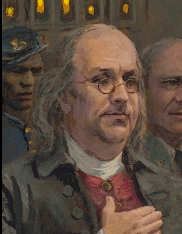
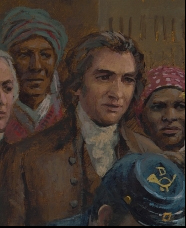
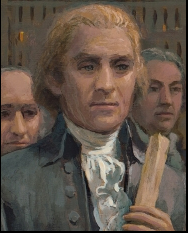 Divine authorship of our Constitution is the main reason that the U. S. is the best country of all the countries. So it's important that we immortalize that in our art.
Along with the requisite historical figures flanking the Author and Finisher of our Constitution, there are a few "modern" presidents whose presence is worth mentioning. Obviously Ronald Reagan, who by construction was the most benevolently badass President, supports Jesus and His pro-American agenda. Curiously, however, JFK is also represented among the Constitutional vanguard. As the only righteous representative of American liberalism, his inclusion can only be explained by his willingness to kill godless Communists.


The lower half of the painting is given over to a depiction of the modern American public, divided into two groups who, significantly, are on the right- and left-hand sides of Jesus. On His right hand, obviously, are the ordinary, decent Americans who Believe in and Uphold the Constitution. Their simple patriotism is rendered in stereotype: there's a soldier in uniform, a mother with child in arms, and a simple, working-class man in plaid and overalls.


In a laudable effort at racial inclusion, a lone black man is counted among the righteous—presumably because he's got his copy of Skousen in hand. (Non-LDS readers should be advised that W. Cleon Skousen was an influential LDS author in the 50s and 60s, writing on both political and religious topics. Whatever his other accomplishments, politically he was a conspiracy-theoretic crank. To wit: Glenn Beck has recently promoted his books in an ill-conceived effort at instigating a Skousian renaissance.)
Finally, we have a school teacher, who reminds us that education is an acceptable vocation among the righteous, but only if you restrict yourself to no further than secondary education and appear as mousy as possible while actually in the act of teaching.

On His left hand are the wicked, unpatriotic individuals whose nation-hating nature is indicated by their association with The Devil Himself!

Most of the evil are easy to identify. The secular scientist looks smugly down on the proceedings through trendy rectangular frames, his arrogance and godlessness manifest in the way he clutches his copy of Darwin's Origin of Species. (Never mind that over 100 yeas ago Darwinian evolution was officially declared to be compatible with LDS doctrine, or that modern evolutionary synthesis is taught as a matter of course in BYU biology classes.)

The activist judge buries his face in despair, realizing that Jesus is here to save the Constitution by eradicating his evil, liberal rulings (including Marbury v. Madison, which set the precedent for judicial review; I wonder what McNaughton thinks of Brown v. Board of Education?).
Others are harder to puzzle out. I suppose the microphone-toting blonde is an agent of the MSM, peddling her liberal propaganda to a populace of proletarian sheeple? It's hard to say.
It's even harder to guess at the money-counting businessman or the near-to-bursting pregnant woman. Their politics seem ambiguous at worst and Jesus-friendly at best. Why are they condemned to kick it with The Devil Himself?


All sarcasm aside, this painting is beyond absurd; it's odious. It seeks to legitimize a narrow, nasty, and monolithic ideology—one that rewrites history, cheapens patriotism, and demonizes disagreement—under the guise of fine art. It's an affront to any who believe that the LDS faith comes with no political strings attached, that Mormonism neither prescribes nor proscribes any political platform. It's discouraging enough that this sort of painting generates enough demand to keep McNaughton's studio solvent; that it's popular enough to be featured at an educational institution is pathetic.
It has been famously asked why the LDS community, while over-represented in business, law, and politics, produces so few great artists. I believe the answer is bound up in the kind of art the LDS community wants to consume, which, based on the preceding, isn't very good. Art challenges, is subtle, is occasionally subversive or controversial. And the rank-and-file LDS community isn't interested in controversy or subtlety, but in consuming media that brazenly reinforces its worldview. So for every Orson Scott Card, Minerva Teichert, or even Arnold Friberg (who managed a much more tasteful synthesis of spirituality and patriotism), there are dozens of Stephanie Meyers, Janice Kapp Perrys, and Michael McLeans. Jon McNaughton is merely a particularly egregious example of the countless LDS artists whose work does not inspire, but ploddingly reinforces stale, suffocating orthodoxy.
And that isn't art. It's kitsch. It's the opposite of art. It destroys art. It destroys souls.
[PS: It turns out you can read McNaughton's interpretation of the painting, as well as his response to "liberal" criticism. I think you will find his rhetorical chops exactly commensurate with his artistry!]
Reconnecting with our Utah roots, Amanda and I wandered around BYU campus for a few hours, eating lunch at the Cougareat, visiting old classroom halls, and eventually perusing the BYU bookstore. In addition to the usual university bookstore fare—hats, T-shirts, and textbooks—there's also a candy store, a floral shop, and a gallery where you can purchase art frames and (mostly LDS-themed) paintings.
You can also purchase terrible, terrible shit.
While browsing the gallery I came across this painting, prominently displayed, by Utah-based painter Jon McNaughton:
Initially I just laughed at what I considered a simplistic, oh-so-Utah expression of religion-cum-patriotism, appropriately rendered in the artless schlock of Thomas Kinkade. As I looked closer and realized the specificity of the artist's "message", however, my emotions began to vacillate between acute annoyance and a long-shot hope that this thing might be a marvelously subtle joke.
Sadly, McNaughton earns no points for irony. His painting may look like an exercise in self-caricature, but the humor is unintentional. That you might understand my frustration—and that I might blow off a little steam—allow me to turn my trained artistic eye on this painting and provide a critical exposition.
The central focus of the painting is Jesus Christ holding the U. S. Constitution up to the world.
Along with the requisite historical figures flanking the Author and Finisher of our Constitution, there are a few "modern" presidents whose presence is worth mentioning. Obviously Ronald Reagan, who by construction was the most benevolently badass President, supports Jesus and His pro-American agenda. Curiously, however, JFK is also represented among the Constitutional vanguard. As the only righteous representative of American liberalism, his inclusion can only be explained by his willingness to kill godless Communists.
The lower half of the painting is given over to a depiction of the modern American public, divided into two groups who, significantly, are on the right- and left-hand sides of Jesus. On His right hand, obviously, are the ordinary, decent Americans who Believe in and Uphold the Constitution. Their simple patriotism is rendered in stereotype: there's a soldier in uniform, a mother with child in arms, and a simple, working-class man in plaid and overalls.
On His left hand are the wicked, unpatriotic individuals whose nation-hating nature is indicated by their association with The Devil Himself!
All sarcasm aside, this painting is beyond absurd; it's odious. It seeks to legitimize a narrow, nasty, and monolithic ideology—one that rewrites history, cheapens patriotism, and demonizes disagreement—under the guise of fine art. It's an affront to any who believe that the LDS faith comes with no political strings attached, that Mormonism neither prescribes nor proscribes any political platform. It's discouraging enough that this sort of painting generates enough demand to keep McNaughton's studio solvent; that it's popular enough to be featured at an educational institution is pathetic.
It has been famously asked why the LDS community, while over-represented in business, law, and politics, produces so few great artists. I believe the answer is bound up in the kind of art the LDS community wants to consume, which, based on the preceding, isn't very good. Art challenges, is subtle, is occasionally subversive or controversial. And the rank-and-file LDS community isn't interested in controversy or subtlety, but in consuming media that brazenly reinforces its worldview. So for every Orson Scott Card, Minerva Teichert, or even Arnold Friberg (who managed a much more tasteful synthesis of spirituality and patriotism), there are dozens of Stephanie Meyers, Janice Kapp Perrys, and Michael McLeans. Jon McNaughton is merely a particularly egregious example of the countless LDS artists whose work does not inspire, but ploddingly reinforces stale, suffocating orthodoxy.
And that isn't art. It's kitsch. It's the opposite of art. It destroys art. It destroys souls.
[PS: It turns out you can read McNaughton's interpretation of the painting, as well as his response to "liberal" criticism. I think you will find his rhetorical chops exactly commensurate with his artistry!]
Friday, June 11, 2010
In me you trust
A quick observation:
Over the last twelve months I've climbed six full rungs up the ladder of facial hair trustworthiness, which places me ahead of Abe Lincoln, Wilford Brimley, and Aristotle. I suggest you all take a moment to celebrate me and my meaningful achievements!

(Image credit goes to Matt McInerney, and thanks go to David Malki ! of Wondermark for sharing the image with the beard-going public.)
Over the last twelve months I've climbed six full rungs up the ladder of facial hair trustworthiness, which places me ahead of Abe Lincoln, Wilford Brimley, and Aristotle. I suggest you all take a moment to celebrate me and my meaningful achievements!

(Image credit goes to Matt McInerney, and thanks go to David Malki ! of Wondermark for sharing the image with the beard-going public.)
Subscribe to:
Posts (Atom)

Related Work
-
Temple10 years ago
-
White Dining Table11 years ago
-
school's out forever12 years ago
-
34 for 3413 years ago
-
My New Commitment to a Clean Desk13 years ago
-
becoming a Numerican14 years ago
-
A Noble Knight...14 years ago
-
Peña Nieto y sus libros14 years ago
-
Happiness & Cheer14 years ago
-
Funeral15 years ago
-
Further Portland proof of Fun!15 years ago
-
Long Story Short16 years ago
-
-
-